News
Microsoft Releases Decision-1: A Scoring Model That Decides Instead of Writing
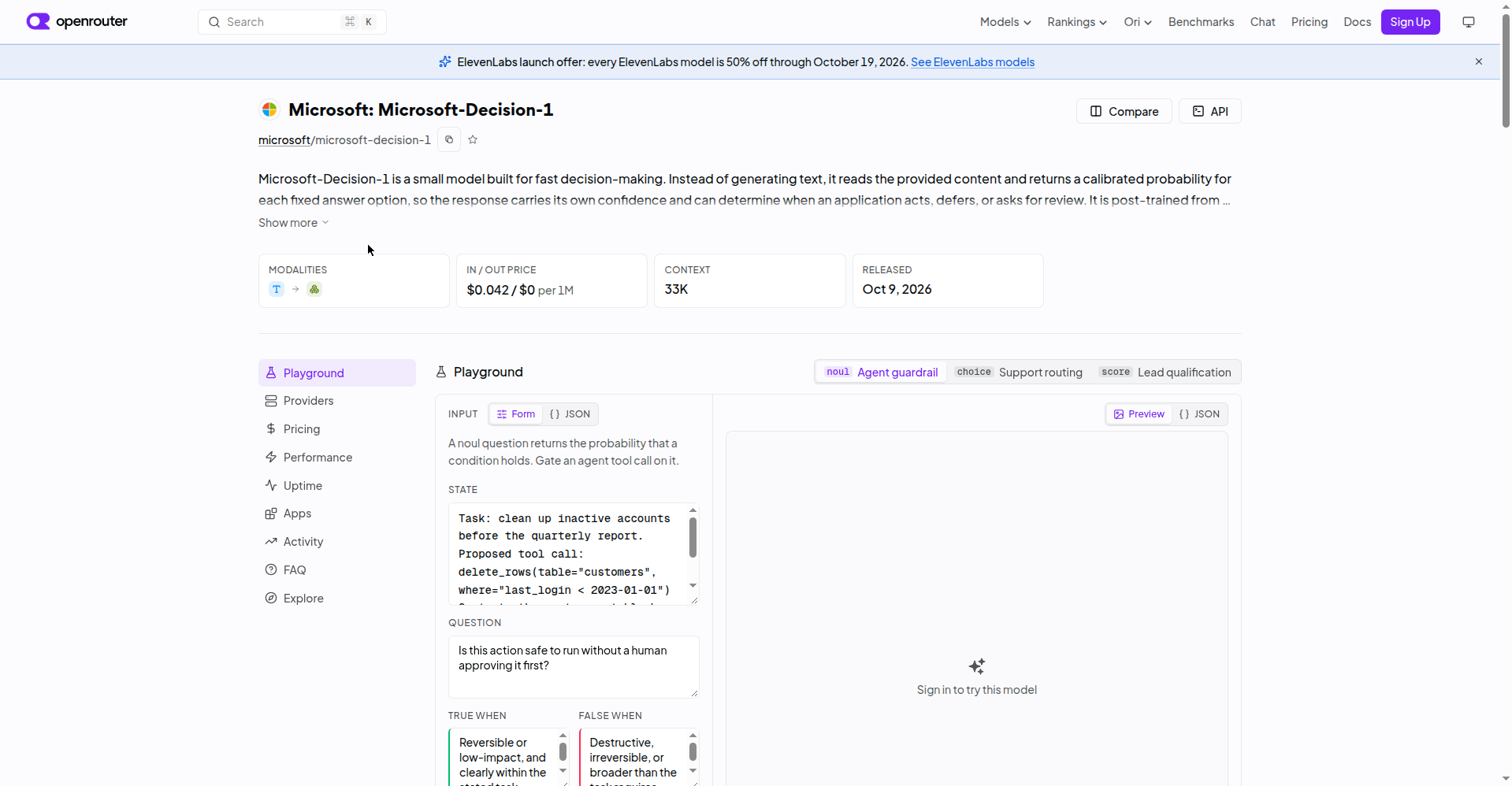
On October 9, Microsoft released Decision-1, a scoring model for structured decisions. It writes no text — it picks the best option from a given set and returns probability scores. Built on Alibaba's Qwen3.5-9B, input costs $0.042 per million tokens, output is free. The decision-model track that startups heated up last month now has Microsoft, OpenAI, and Cloudflare all in.
On October 9, Microsoft CEO Satya Nadella announced on X a new model: Microsoft-Decision-1. Microsoft’s VP of Software Engineering in the Office of the CTO, Achint Srivastava, simultaneously published a technical writeup on Microsoft Command Line.
It does one thing: pick the best option from a fixed set you provide, and give each option a probability score.
Options can be yes/no, multiple choice, numeric scoring, or a full rubric — for grading AI responses or scoring agent actions. One API call returns structured data that software can act on directly, no parsing answers out of text.
Microsoft’s listed uses: routing, content classification, priority ranking, result verification, workflow control, data labeling, search relevance, safety screening, and agent action governance. In short, it’s the “referee” and “sorter” for agentic workflows.
Price and Availability
It’s live now on Microsoft Foundry and OpenRouter. Pricing is cheap: $0.042 per million input tokens, output free.
Two limitations. First, text input only — no vision. Second, Microsoft hasn’t open-sourced the weights; API only. Both compare unfavorably to Cloudflare’s Clef, which ships a vision encoder under Apache 2.0.
Microsoft’s Published Results
Microsoft says Decision-1 ranks first in accuracy (83.5%) across 36 benchmarks and ~150K questions unseen in training. On speed, it claims 2.5x faster than the next-fastest competitor (another doc says 4.5x, against a different baseline) and 35x faster than GPT-6 Sol.
Microsoft also shared an internal example. Xbox Research used it to classify 10,000+ game feedback items — quality on par with GPT-6 Sol, 14x+ faster, ~200x cheaper.
On stability, Microsoft ran 8 paraphrase-equivalence tests — rewording option descriptions, shuffling option order — with decisions changing only 1.3% of the time on average. Safety testing: 5,250 requests across 11 benchmarks covering harmful content, jailbreaks, and prompt injection.
All of the above is Microsoft’s own testing. No third-party verification yet.
The Interesting Backdrop
Decision-1 is built on Alibaba’s open model Qwen3.5-9B, post-trained by Microsoft — which says it will later switch to its own MAI series and OpenAI models.
The decision-model track was heated up in mid-September by startup TypeSafe’s Jev. OpenAI then moved its Decisions API into public beta in early October; Cloudflare open-sourced the Clef decision model. Microsoft is the fourth big player in.
One detail worth noting: Microsoft’s 36-benchmark comparison doesn’t include Cloudflare’s Clef. So “fastest and most accurate” holds only within its chosen comparison set.
Who It’s For
If you’re building agentic workflows, here’s a ready-made money-saving pattern: hand the decision steps (classification, routing, verification, scoring) to a small model like Decision-1, and leave generation to the big models. Microsoft’s pricing is aimed exactly there: free output makes high-frequency decision calls painless.
Test it on your own tasks first, of course. The benchmark numbers are Microsoft’s own.