News
Alibaba Plays Its Full-Stack AI Hand: Qwen 4 Training, Zhenwu V900 Chip in Mass Production Next Year
On September 22, Alibaba unveiled its full-stack AI strategy at the Apsara Conference in Hangzhou: Qwen 4 is training, future versions planned at 5–10 trillion parameters; its in-house Zhenwu V900 AI chip is 3x the previous generation, mass production in Q1 2027; Alibaba Cloud targets over 20GW of global data center capacity by 2032.
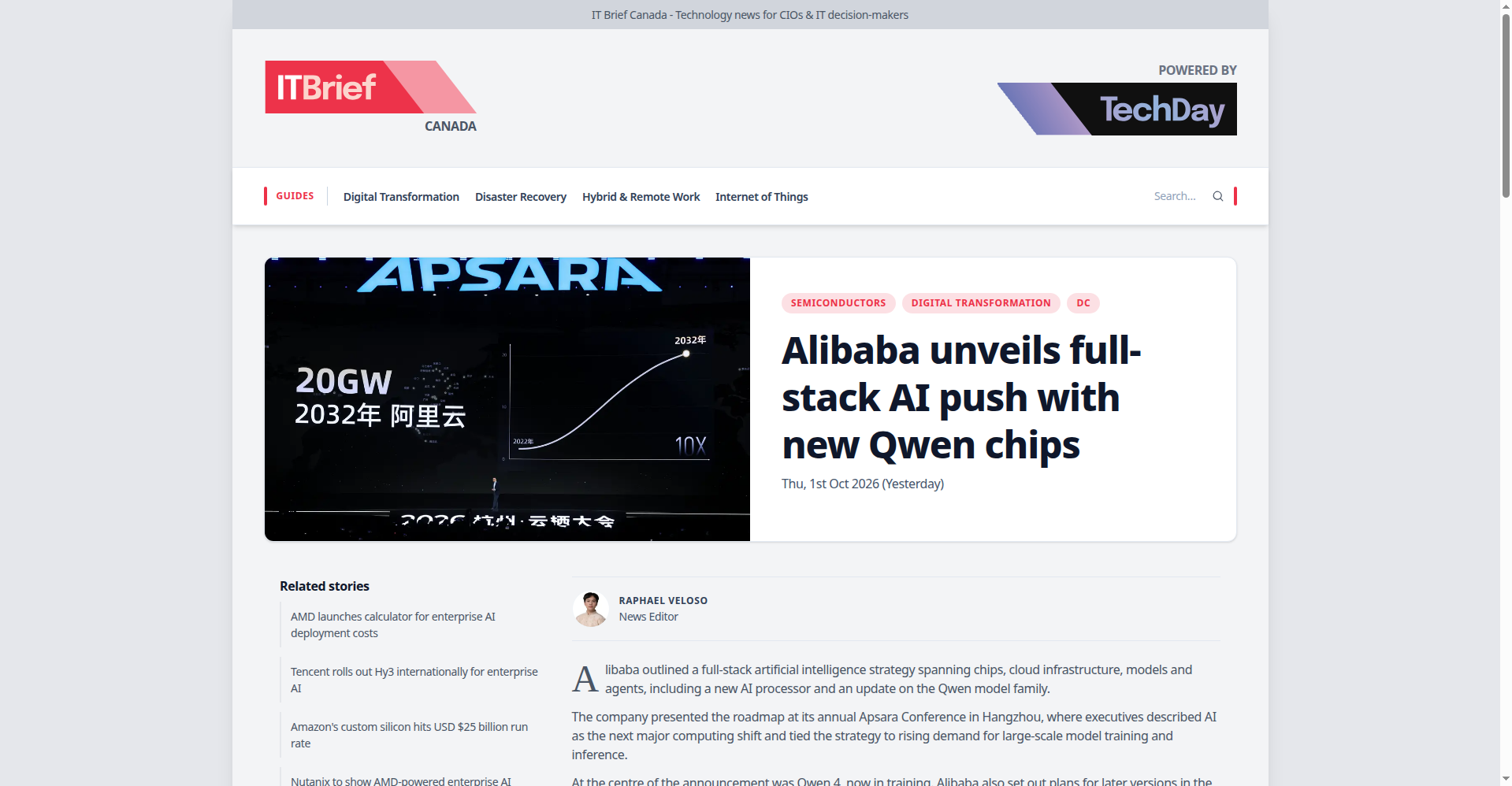
On September 22, Alibaba unveiled its full-stack AI strategy at the Apsara Conference in Hangzhou.
Chips, cloud infrastructure, models, and agents — all four lines presented at once. It’s the first time Alibaba has put “full stack” front and center.
Models: Qwen 4 Training, Qwen 5 Planned at 5–10 Trillion Parameters
The biggest draw was the model roadmap. Alibaba confirmed Qwen 4 is in training, and shared longer-range plans: Qwen 4.5 and Qwen 5 at an estimated 5–10 trillion parameters.
For reference, the current flagship Qwen3.8-Max is, per public data, a 2.4-trillion-parameter sparse MoE with 95B active per token and 1M-token context.
One distinction matters: 5–10 trillion is a roadmap number, not a released spec. More parameters don’t equal stronger, and total parameter counts in sparse architectures don’t convert directly to capability.
Alibaba also disclosed progress on “recursive self-improvement” (RSI). Qwen3.8-Max completed 33 rounds of automated iteration in just over a month — covering process design, data validation, experiment iteration, and error diagnosis — lifting its Artificial Analysis score from 40 to 45.
The multimodal lineup got updates too: Qwen3.8-LiveTranslate simultaneous interpretation cut latency (LAAL metric) from 2.8s to 2.3s; Qwen-Audio-3.1-TTS-Next generates dialogue and ambience from a single script for audiobooks, film, podcasts, and games; speech recognition, text-to-speech, and real-time voice tools were all refreshed; image generation gets Qwen-Image 3.1 later this year with transparent-background generation and image editing.
Chips: Zhenwu V900, 3x the Previous Generation
Alibaba’s chip design arm T-Head (Pingtouge) launched the Zhenwu V900 AI processor.
Alibaba’s numbers: 3x the performance of May’s Zhenwu M890; 216GB of VRAM; 1,200 GB/s chip-to-chip interconnect bandwidth; FP8 and FP4 low-precision formats for both training and low-precision inference.
Mass production and commercial availability target Q1 2027. Everything public so far is official spec — no independent third-party testing yet. Price, power, and process node: all undisclosed.
Cloud: 20GW+ Data Center Capacity by 2032
Alibaba CEO Eddie Wu set a long-term goal: by 2032, Alibaba Cloud will operate over 20GW of data center capacity worldwide.
His reasoning: compute demand will keep growing sharply. His words: “The total amount of machine thinking today is still less than 3% of human thinking. If that grows to 1,000x human capability, simple math tells us machine thinking has enormous room to grow.”
On cloud strategy, Alibaba proposed the “agentic cloud” in three layers: the model layer (AI Native Cloud, for training and inference), the agent layer (Agent Native Cloud, for agent deployment and operation), and the context layer (Context Engine, for real-time data and long-term memory).
Alibaba Cloud reportedly also plans new cloud regions in Turkey, Finland, and the Netherlands over the next 12 months, plus data center expansions in multiple markets.
Reading the Launch
Split the announcements into three buckets and it gets much clearer.
Confirmed: V900 specs, Qwen 4 in training, the multimodal updates, the event itself.
Roadmap: V900 mass production in Q1 2027, Qwen 4.5/5 at 5–10T parameters, the 2032 20GW target.
Vendor claims: V900’s 3x performance, the score lift from 33 self-improvement rounds.
Not yet disclosed: independent V900 testing, price, power, process; exact ship dates for Qwen 4, 4.5, and 5.
Overall, Alibaba is betting on vertical integration: designing its own chips, building its own clusters and storage, training its own models, running its own cloud — then selling the whole stack. If the roadmap lands, what it sells isn’t one model but the infrastructure models run on.
The next phase of AI competition won’t just be about parameter counts — it’ll be about who can connect training, serving, distribution, integration, and monetization into one chain. This launch is Alibaba’s bet in that direction.