News
Alibaba Puts Qwen Into Glasses: N1 Series Goes on Sale in China
Alibaba unveiled its Qwen Glasses N1 and N1 Pro at a Hangzhou event on October 13 and put them on sale in China, alongside Bose co-engineered Qwen Clip earbuds.
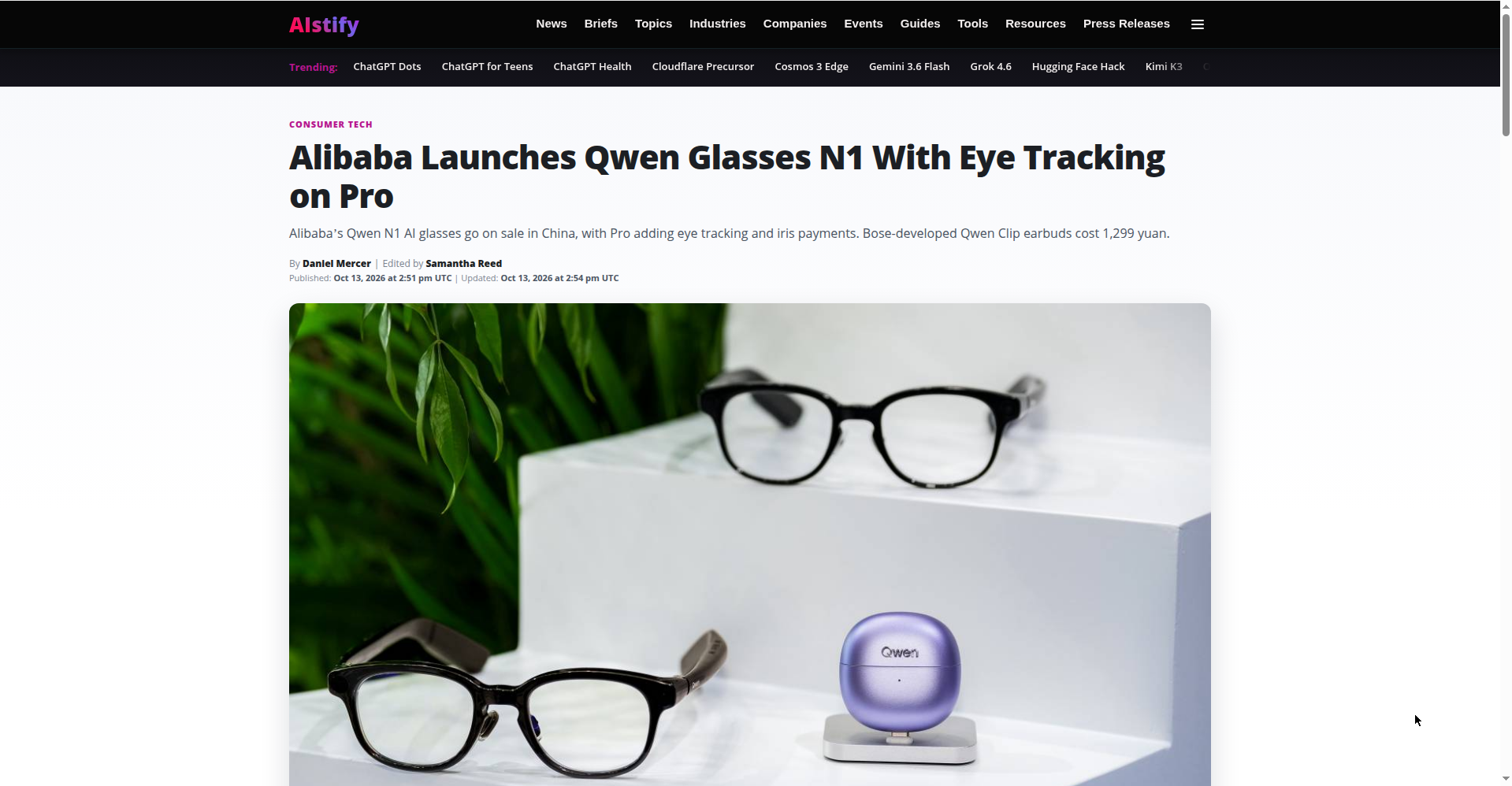
Alibaba put its Qwen AI assistant into eyewear this week. The company unveiled its new Qwen Glasses N1 series at an event in Hangzhou on Tuesday, October 13, and put the devices on sale in China the same day. Alongside the glasses, it launched Qwen Clip, a pair of open-ear AI earbuds developed with Bose.
The launch is Alibaba’s clearest move yet to turn its AI models into consumer hardware. The glasses are not a concept or a developer kit. They are a retail product, sold through Taobao, Tmall, JD.com, and Douyin, priced to compete directly with Meta’s Ray-Ban smart glasses.
What the glasses do
Both models carry a 50-megapixel camera for first-person capture, and both run Alibaba’s Qwen assistant. Users talk to the assistant through bone-conduction microphones, and the glasses handle translation, meeting minutes, voice-based task handling, shopping, payments, and health tracking.
The camera is the biggest hardware step up from the first edition, which arrived roughly a year earlier. Alibaba says the new glasses offer up to 25 hours of standby time or nine hours of music playback on one charge.
The two models split on interaction. The standard N1 is the everyday version. The N1 Pro adds eye tracking, so a wearer can trigger object recognition or confirm actions by looking. It also adds real-time vital-sign monitoring and iris-based payment verification, developed with Ant Group.
Prices
The standard N1 starts at 2,999 yuan, about $450, before discounts. The N1 Pro costs 3,499 yuan, about $520. Qwen Clip is priced at 1,299 yuan.
Those are list prices. After China’s national subsidies and limited-time discounts, reported street prices drop to 2,218 yuan for the N1, 2,600 yuan for the N1 Pro, and 1,099 yuan for the earbuds. The gap between list and subsidized prices is large enough that buyers in China will mostly see the lower numbers.
At list price, the N1 is no cheaper than Meta’s Ray-Ban glasses. Alibaba is competing on features and on how deeply the glasses tie into its own services, not on undercutting the market leader.
Qwen Clip, the earbuds
Qwen Clip is Alibaba’s first AI earbuds. They use an open-ear, clip-on design co-engineered with Bose, and they run the same Qwen assistant as the glasses.
The earbuds support real-time translation across 89 languages, AI transcription and notes, and voice-driven tasks. Like the glasses, they are positioned as a way to carry an AI assistant through the day without pulling out a phone.
A launch months in the making
The hardware was not a surprise. Alibaba first showed the N1 family at its Apsara Conference in September, alongside two other Qwen devices: Qwen Book, an agentic computer running a Qwen-centered operating system, and QwenNote A2, a pocket recorder that turns conversations into context for workplace agents.
Pre-orders for the wearables opened on September 22. October 13 turned the preview into a retail launch, with immediate availability on China’s major e-commerce platforms.
Why Alibaba is building hardware
Alibaba describes itself as a full-stack AI provider, spanning data centers, models, software, and now end-user devices. CEO Eddie Wu reiterated that ambition last month, framing hardware as a natural extension of the company’s AI stack rather than a side business.
The logic mirrors Meta’s. Meta has turned smart glasses into an entry point for its Muse AI assistant, expanding its lineup last month with a simplified, camera-free model priced at $349. Alibaba wants the same thing: glasses as the place where people meet its assistant first, with shopping, payments, and services one voice command away.
The difference is distribution. Meta reaches billions of people through Facebook, Instagram, and WhatsApp. Alibaba’s advantage is commerce: the glasses can connect directly to Taobao and Tmall, Alipay payments, and its logistics network. Whether that turns into a real edge depends on how useful the assistant proves in daily use, not on the spec sheet.
This is also a second-generation effort, not a first try. The original Qwen glasses arrived about a year earlier, in November. The N1 series tightens the integration with the Qwen assistant and adds the Pro tier, suggesting Alibaba learned enough from the first edition to invest in a broader lineup rather than treating glasses as an experiment.
What to watch
Two questions matter more than the launch-day specs. The first is reliability. Smart glasses live or die on whether the assistant understands requests, transcribes accurately, and handles permissions and payments without mistakes. A device that needs constant correction will sit in a drawer, no matter how good the camera is.
The second is geography. The launch is China-only, and Alibaba has not announced international availability or pricing. Meta’s glasses sell globally. Until Alibaba says otherwise, the N1 series is a test of whether a Chinese tech giant can build a consumer AI hardware business at home before taking it abroad.
For now, the signal is clear: the AI assistant race is no longer just about chatbots and APIs. It is about who gets a camera, a microphone, and a voice assistant onto people’s faces, and Alibaba has just put its entry on store shelves.
Source: Bloomberg reporting on the October 13 Hangzhou launch, as carried by Techmeme and BizToc; AIstify; TechNode; Lapaas Voice.