Tutorial
51 Seed Keywords That Reveal Endless Product Ideas
One combinatorial trick for never running out of product ideas: pair a universal root word like generator or converter with a niche object, and each pairing is a candidate tool site.
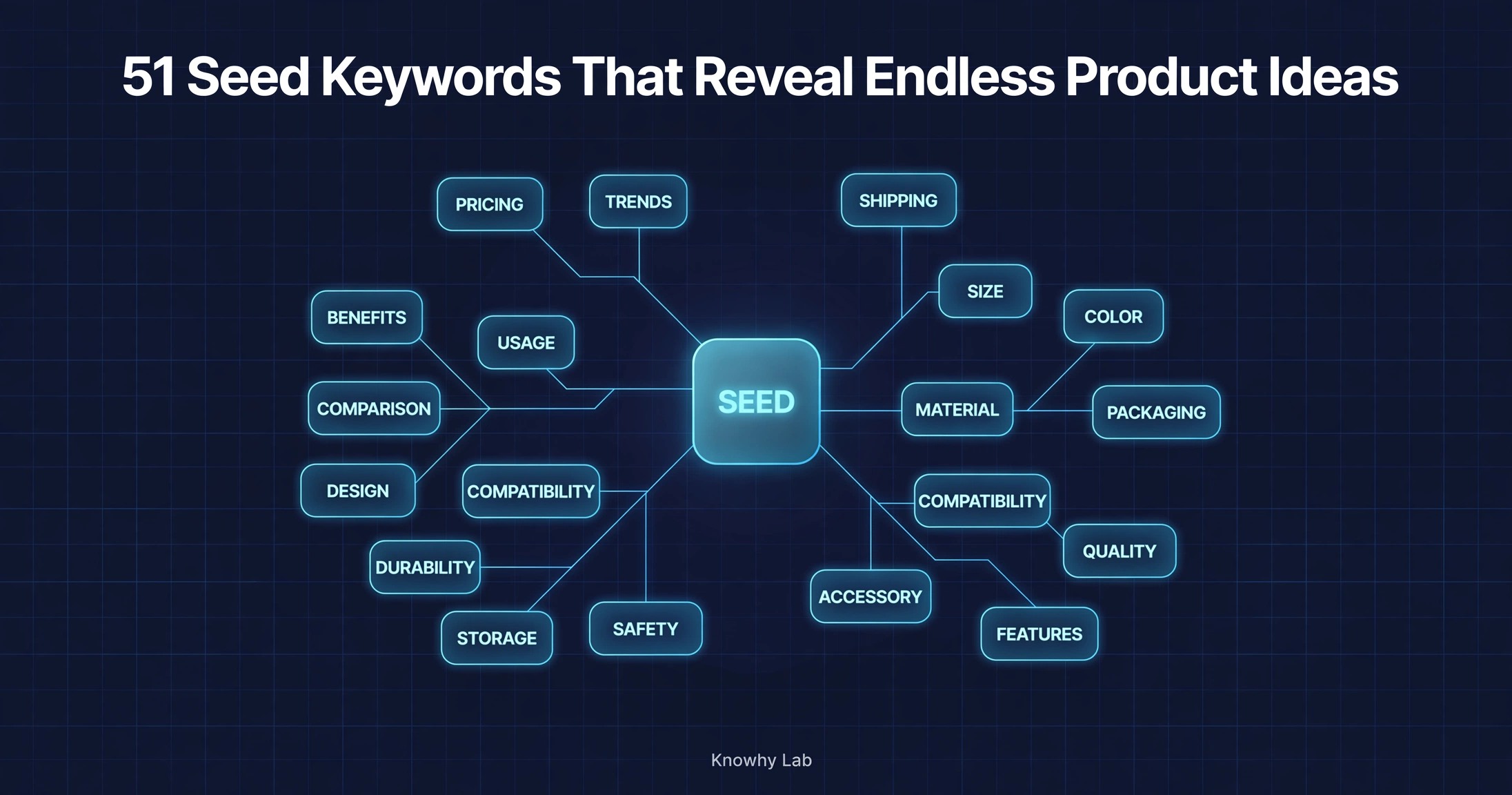
“I don’t know what to build” is the most common stall in indie building, and it has a mechanical fix. Product ideas do not have to come from inspiration. They can be generated the way combinations are generated: take a root word that names a repeatable action people want done, pair it with an object people care about, and each pairing is a candidate product. This article explains the trick, why it works, and how to avoid its trap.
1. What a root word is
A root word names a job people repeatedly hire software to do: convert, generate, calculate, check, track, plan, compare, remove, merge, compress. These verbs are “universal” because they apply to almost any domain. Nobody searches for them alone, but millions search for them attached to something specific.
Think of the root word as the engine and the object as the fuel. The engine is reusable; the fuel changes with every niche.
2. The combination formula
The formula is simple: root word plus object equals candidate.
- A document object plus “generator” becomes a resume generator, a cover-letter generator, an invoice generator.
- A media object plus “converter” becomes an image converter, an audio converter, a video compressor.
- A money object plus “calculator” becomes a mortgage calculator, a freelance-rate calculator, a tip calculator.
One root word pairs with dozens of objects. Dozens of root words times dozens of objects gives you hundreds of candidates in an afternoon. That is the whole trick, and it is why a short list of root words is worth more than a long list of finished ideas: ideas expire, but the generator keeps producing.
3. Why the formula fits indie builders
Each pairing has three properties that make it unusually buildable:
- One clear job. A converter converts. There is no ambiguity about what to build or what “done” looks like.
- One indexable page. A single tool page can rank for its exact keyword, which keeps the SEO work proportional to the build.
- Natural monetization. Tool-intent traffic attracts advertisers, and a working free tool converts a fraction of users to a paid tier or an affiliate click.
Big companies ignore most of these pairings because each one is too small to matter at their scale. That neglect is exactly the opening.
4. The trap: a combination is a hypothesis, not a validation
This is where most people misuse the trick. A pairing that sounds good in a spreadsheet is not demand. Every candidate must survive three checks before you build:
- Does anyone search for it? Check real search volume for the exact pairing. Zero volume means the combination is clever but unwanted.
- Can you rank for it? Look at who holds the top results. If established tools with strong domains own the page, move on; if forums, thin pages, or outdated tools rank, the door is open.
- Is the intent tool-like? Some pairings attract researchers, not users. If the searchers want to read about the topic rather than do the job, a tool page will not convert.
Generate hundreds, validate dozens, build one. The funnel is the method; the list is just raw material.
5. A worked mini-example
Take the root word “checker” and walk three pairings through the checks in your head:
- Pair it with a common document type. Search volume exists, but the top results are entrenched products with huge domains. Verdict: real demand, unwinnable for a new site. Skip.
- Pair it with a niche professional workflow. Modest volume, top results are forum threads and a decade-old free tool. Verdict: winnable, and the audience has money. Shortlist.
- Pair it with a hobbyist collectible. Tiny volume, no advertisers. Verdict: a hobby, not a business. Skip.
Same root word, three different outcomes. The combination creates the options; the validation picks the winner.
6. Build the list, then screen ruthlessly
Keep a running sheet of pairings and their check results. Most will fail at least one check, and that is the point — failing fast on paper costs nothing, failing after a build costs months. When one pairing passes all three checks, stop generating and start building. You can always return to the sheet for product number two.
The root-word list is a well that never runs dry. But water is only useful after you test it.
Series: Build Overseas Websites with GeFei
This article is based on GeFei’s shares, reorganized in our own words. Source: https://github.com/qiayue/opengefei