Tutorial
Screening Your First Demand Before You Build
Ideas are infinite, but your first build must be winnable. A practical walkthrough: filter candidates by difficulty and ad value, inspect the results page, check the trend, and skip the traps.
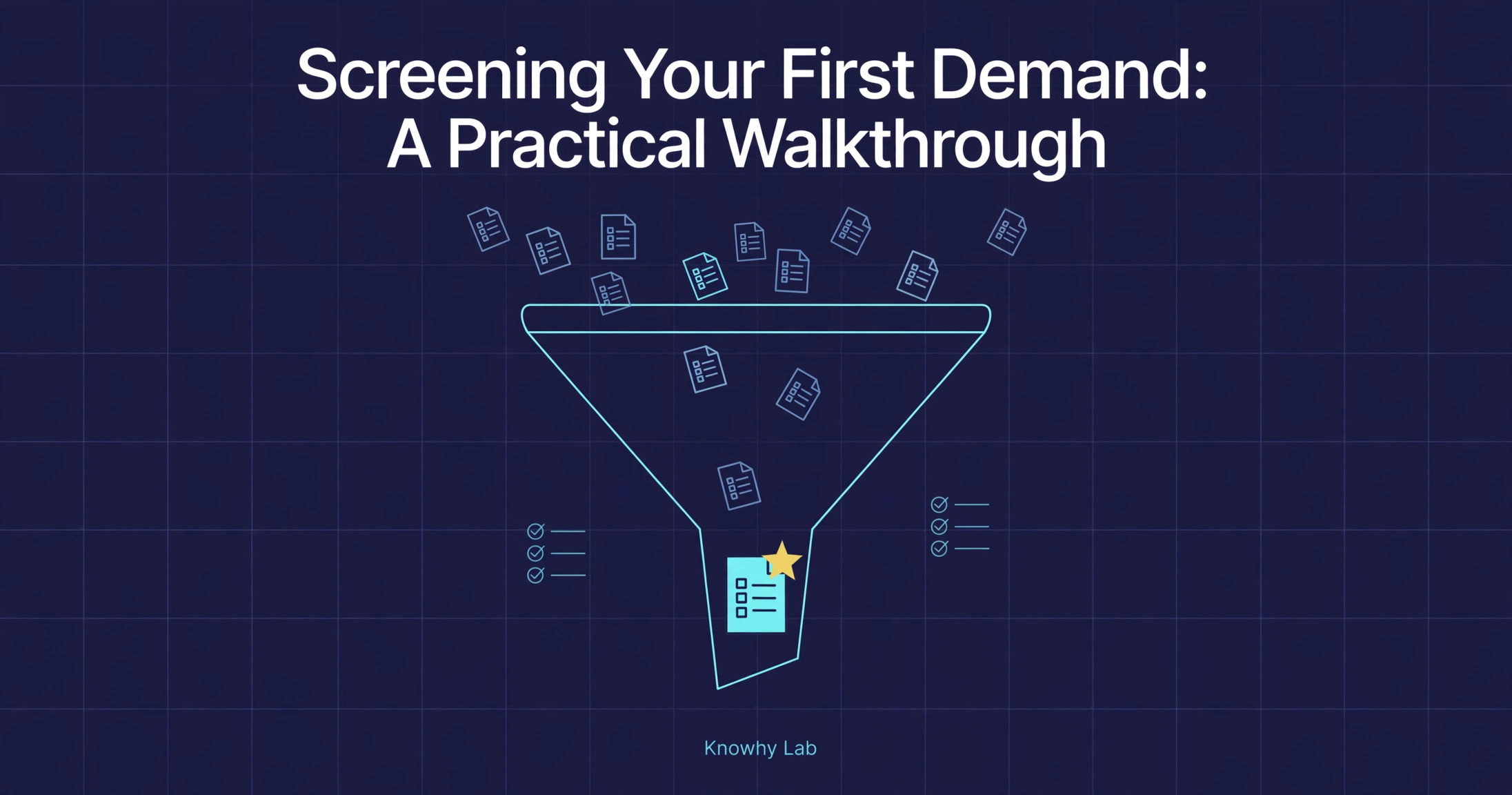
Generating product ideas is easy; choosing the right first one is the skill. A beginner’s first build must clear a higher bar than “good idea” — it must be winnable by a new site, worth money, and durable enough to compound. This article is a practical walkthrough of the screening funnel: how to turn a pile of candidates into one demand worth building.
1. Start with a pile, not a pick
Screening only works on volume. Begin with twenty to thirty candidates — from the root-word combinations in the previous article, from competitor keyword reads, from anywhere. Do not fall in love with any of them yet. The funnel’s job is to kill ideas cheaply, on paper, before they cost you months.
Put each candidate in a simple sheet with columns for the checks below. Most rows will die at some column. That is success, not failure.
2. Filter one: keyword difficulty
Open each candidate in a keyword tool such as Semrush and note its keyword difficulty (KD). As a new site with no authority, your rule is blunt: only low-difficulty keywords survive.
Difficulty is not a moral judgment on the idea; it is a budget. A high-difficulty keyword is a fight against sites with years of backlinks, and a new site loses that fight regardless of how good the product is. You are not avoiding competition forever — you are sequencing it. Win the easy fights first, build authority, then take on harder ones from strength.
3. Filter two: commercial value
For the survivors, check the cost-per-click (CPC). CPC is advertisers voting with money: if companies pay meaningful amounts to reach these searchers, someone has already proven the traffic converts.
The sweet spot for a first build is low difficulty plus real CPC. Low difficulty means you can rank; real CPC means the ranking pays. A keyword with traffic but no CPC is a warning sign — it may be curiosity traffic that nobody can monetize. A keyword with CPC but brutal difficulty is a prize you cannot reach yet.
4. Filter three: read the results page yourself
Tools get you this far; now use your eyes. Search the keyword in Google and study page one as a competitor would:
- Who ranks? If the top results are household-name domains and polished products, the difficulty score was telling the truth — move on. If they are forum threads, thin affiliate pages, or tools that have not been updated in years, the door is genuinely open.
- What format wins? If every result is a tool and you planned a blog post, you misread the intent. Match the format the searchers already chose.
- Is there a quality gap you can name? “Faster,” “cleaner,” “handles one more case” — if you cannot state the gap in one sentence, you do not have an edge yet.
This manual read catches what scores miss. A low KD with a surprisingly strong page one is a trap; a moderate KD with a weak page one is an opportunity.
5. Filter four: check the trend
Open Google Trends for the surviving keywords. You are looking for direction, not just height:
- Flat or rising: healthy. The need is stable or growing.
- One sharp spike then collapse: a news or fad cycle. By the time you rank, the wave is gone.
- Steady decline: the need is being absorbed elsewhere, often by a platform feature. Do not build on a sinking keyword.
A first product needs time to rank and compound. Only a durable trend gives it that time.
6. Know the classic traps
Some candidates pass every filter and still fail. Learn the patterns:
- Brand terms in disguise. A keyword that looks generic but is really people searching for one specific product. You cannot outrank the brand for its own name.
- Queries Google answers directly. If the answer fits in a snippet — a definition, a simple conversion — there is no click left for you.
- Free-pirate intent. Some searches want the thing without paying anyone, ever. High volume, zero monetization.
- Enterprise-only needs. Real demand, but the buyer is a procurement department, not a person with a credit card. Wrong game for an indie tool.
When a candidate smells like one of these, kill it and move on. The sheet has more rows.
7. Commit to the survivor
When one candidate passes all four filters and none of the traps, stop screening. Do not keep hunting for a “better” idea — the marginal gain of a slightly better keyword is dwarfed by the cost of another month of indecision.
Commit to a time box, typically around ninety days: build the smallest version, publish, do the SEO basics, and measure. The screening got you a winnable fight; now the only variable is execution. And the sheet of killed ideas is not waste — it is the pipeline for product number two, three, and four.
Series: Build Overseas Websites with GeFei
This article is based on GeFei’s shares, reorganized in our own words. Source: https://github.com/qiayue/opengefei