Tutorial
How to Find a Web Product's First Real Demand
Stop guessing what to build. Reverse-engineer a winning niche site's traffic sources and top search keywords with traffic and webmaster tools, and let proven demand pick your product for you.
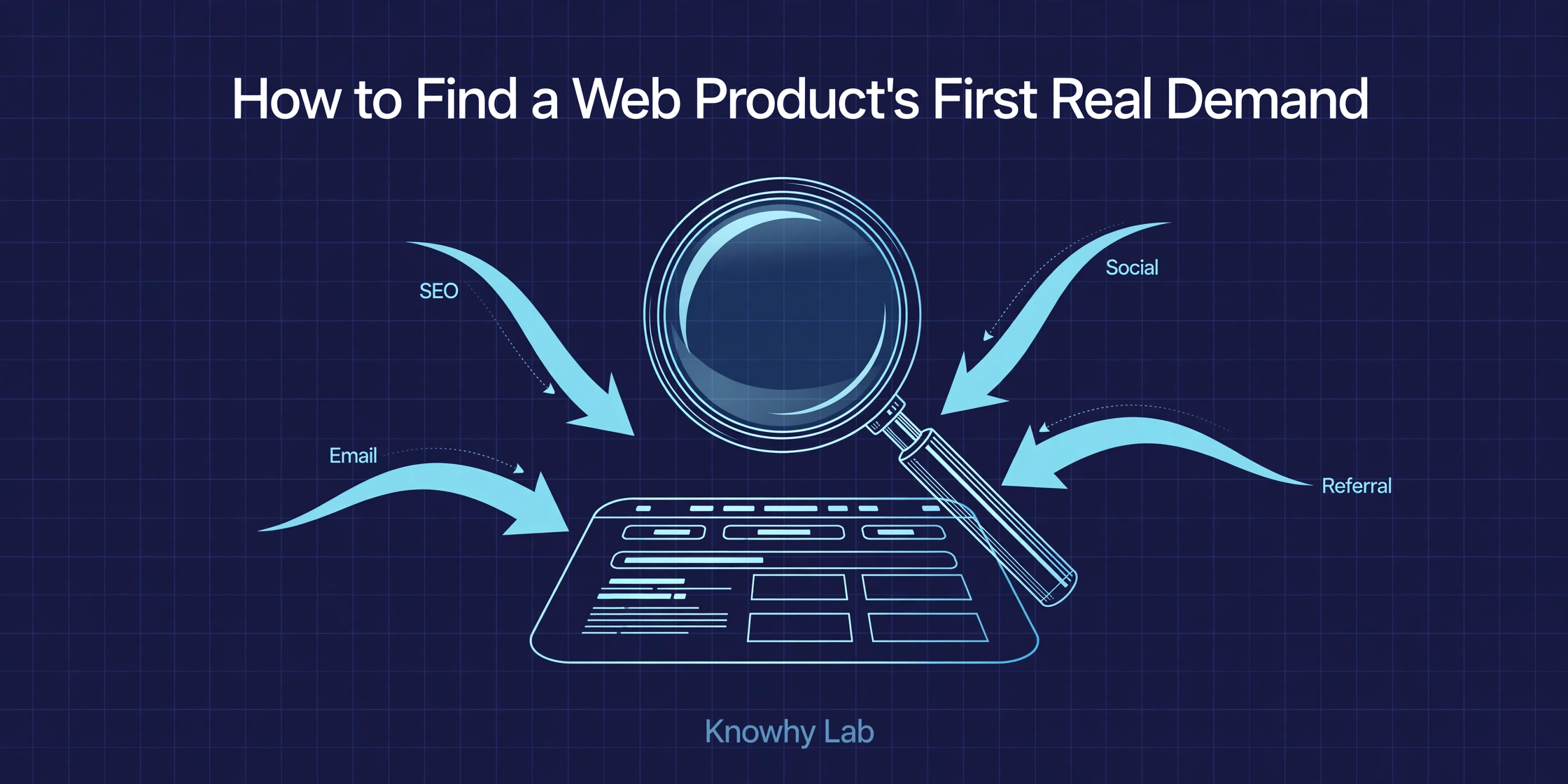
Most indie builders start from an idea in their head and spend months building it, only to discover nobody wanted it. There is a cheaper way to start: let demand that is already proven pick the product for you. The method is forensic, not creative. Find a site that already wins in a niche you could serve, take its traffic apart with public tools, and read the demand off the data. This article walks through that method in plain steps.
1. Start from a winner, not from a blank page
Ideas are abundant; verified demand is scarce. A site that already ranks and already earns has done the expensive experiment for you. Your job is not to copy it, but to read what its traffic proves: which needs are real, which keywords carry them, and where the gaps are.
Pick a niche site you could plausibly out-execute — ideally a small independent tool or content site, not a giant. The smaller the winner, the closer it is to your starting line, and the more its playbook transfers.
2. Split its traffic by source
Open the site in a traffic-estimation tool such as Similarweb and look at the traffic-source mix first, before any keyword:
- Mostly search: the site lives on search demand. Its keywords are the product roadmap. Read on.
- Mostly direct or brand: the site lives on reputation. Harder to replicate with SEO alone, but its content themes still reveal what the audience cares about.
- Meaningful social or referral share: check which pages get shared or linked. Shared pages reveal demand with emotional or practical punch.
The source mix tells you which game the site is playing. For a beginner, a search-heavy site is the best textbook, because its demand is written out in keywords you can read.
3. Read the keywords like a product spec
Now open the site’s top organic keywords and sort by traffic share. Each keyword that sends a meaningful share of visits is one proven need, stated in the searcher’s own words. Ask three questions about each:
- What job is the searcher hiring for? A keyword like a format conversion or a calculation is a job, not a topic. Jobs become tools.
- Can I serve it as well or better? If the top results are thin, outdated, or ad-stuffed, the bar is low and the opening is real.
- Would it pay? Tool-intent keywords attract advertisers and buyers; pure curiosity keywords often do not. Demand you cannot monetize is a hobby, not a product.
One site can hand you dozens of such reads. Write them down. This list is your candidate pipeline.
4. Use backlinks to find durable demand
Keyword tools show what brings traffic today. Backlink data shows what people considered worth citing over years. In a webmaster or backlink tool, sort the site’s pages by referring domains. Pages that earned links organically usually solve a durable, reference-worthy problem — a calculator, a reference table, a definitive guide.
Durable demand matters because search traffic compounds only when the need does not expire. A page that has earned links for three years is a safer bet than a keyword that spiked last month.
5. Turn one keyword into the smallest buildable product
Pick one keyword from your list that passes all the filters: real job, beatable results, monetizable intent. Then build the smallest thing that serves that job better than page one does. Not a platform. Not a suite. One page, one job, done noticeably better — faster, cleaner, or more complete than what ranks.
This discipline is the whole point of the method. The demand is already proven, so your only risk is execution, and you shrink that risk by keeping the build tiny.
6. Make it a habit
The method works once, but it compounds as a habit. Every site you encounter becomes a case study: check its traffic mix, glance at its top keywords, note what the data proves. Over months, you build an instinct for which needs are real and which are mirages — and a notebook full of candidates for your next build.
Demand is not something you invent. It is something you discover, in public data, before you write a line of code.
Series: Build Overseas Websites with GeFei
This article is based on GeFei’s shares, reorganized in our own words. Source: https://github.com/qiayue/opengefei