News
DeepMind Opens Robotics Hardware Lab in Boston
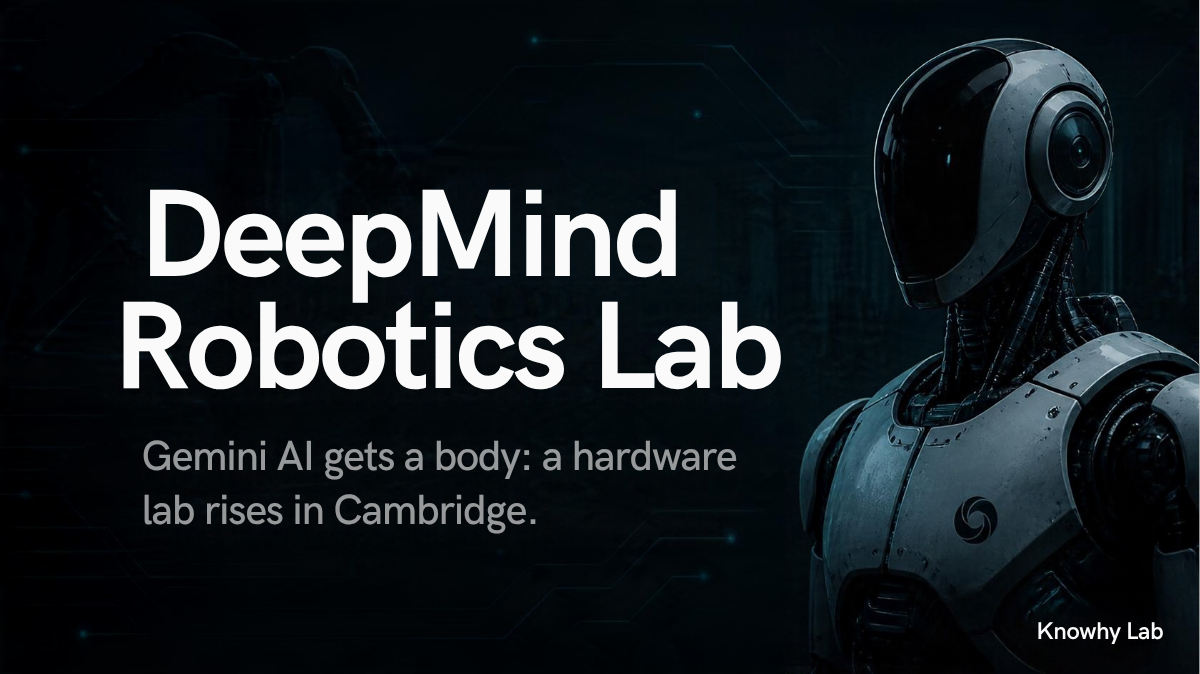
Google DeepMind is building a dedicated robotics hardware lab in Cambridge, Massachusetts, aiming to turn its Gemini AI models into physical machines. The project was announced by a former Boston Dynamics CTO.
A New Lab for Physical AI
Google DeepMind is setting up a dedicated robotics hardware laboratory in Cambridge, Massachusetts. The news was reported on Oct 15, 2026, by Hoodline, which cited reporting from The Boston Globe. This is not a software-only venture. The lab will host a new team that develops hardware based on Google DeepMind’s AI and robotics research. The stated goal is direct: turn Gemini AI models into working machines.
The announcement came from Aaron Saunders. Saunders recently joined Google DeepMind from Boston Dynamics, where he served as chief technology officer. He announced the project on LinkedIn. That is the primary source of the information. There has been no official press release from Google DeepMind as of this writing.
Saunders hinted that the lab could open in the coming year. That timing is not confirmed. Treat it as an estimate, not a hard date.
Why Cambridge, Massachusetts
The location is not random. Cambridge sits in the middle of the Greater Boston robotics cluster. That area is home to Boston Dynamics and a dense network of robotics startups, research labs, and university programs. This is the same region where Google previously had a major robotics footprint — before it sold Boston Dynamics years ago. That sale was a retreat from physical hardware. This new lab is a return.
The move signals a strategic shift. Google DeepMind is pushing into what is often called “physical AI.” That means moving beyond software models that generate text, images, or code, and into systems that control bodies — arms, legs, grippers, sensors. The lab’s purpose is to give those AI models a physical form.
The Team and the Lead
Aaron Saunders is the public face of this effort. His background matters. At Boston Dynamics, he oversaw the engineering of some of the most advanced legged and humanoid robots in the world. That experience is directly relevant to building hardware that must work in the real world, not just in simulation.
He is now at Google DeepMind. His LinkedIn post did not give many details. No headcount, no budget, no timeline beyond the “coming year” hint. But the fact that he is leading the effort suggests Google DeepMind is serious about hiring people who know how to build durable, physical machines.
The team will be new. It will be based in the Cambridge lab. They will work on hardware that is designed to run Google DeepMind’s AI models, specifically the Gemini line. That means the hardware and the software are being co-developed. The AI is not an afterthought; it is the core requirement.
What “Turning Gemini into Machines” Means
Gemini is Google DeepMind’s multimodal AI model family. It can process text, images, audio, and video. But it has not, until now, been the brain of a physical robot in a dedicated hardware lab. That is the change.
The idea is to take the reasoning, planning, and perception capabilities of Gemini and embed them in a robot. The robot would not just follow pre-programmed paths. It would use the AI model to understand its environment, make decisions, and act. That is a different engineering problem from training a model on a server.
Hardware constraints matter. A model that works in the cloud may not work on a robot with limited battery, limited compute, and real-time latency. The lab will need to solve those problems. That means designing custom boards, sensors, actuators, and power systems. It also means testing those systems in physical environments, not just in software.
A Return to Boston — and a Reversal
Google’s history with Boston robotics is well known. The company acquired Boston Dynamics in 2013. But the fit never worked out, and Google sold Boston Dynamics to SoftBank in 2017. The reasons were never fully public, but reports at the time suggested that Google struggled to turn research robots into commercial products.
Now Google DeepMind is back in the same city, building its own hardware lab. That is a notable reversal. It also puts Google DeepMind in direct competition with Boston Dynamics, which is now owned by Hyundai. The two companies will be hiring from the same talent pool. They will also be working on similar problems: making robots that can walk, grasp, and manipulate objects in unstructured environments.
The competition is not just about robots. It is about AI. Boston Dynamics has its own AI efforts, but it does not have a model like Gemini. Google DeepMind does. That could be a differentiator.
The Broader Physical AI Push
This lab is part of a larger trend. AI labs are moving from pure software to embodied hardware. OpenAI has invested in humanoid robot companies. Figure AI has partnered with OpenAI. Tesla is building Optimus. Meta has its own robotics research. The pattern is clear: if AI is to be useful in the physical world, it needs a body.
Google DeepMind is now joining that push in a concrete way. A dedicated hardware lab is a serious commitment. It is not a research project with a few test rigs. It is a place where engineers will design, build, and iterate on physical systems.
The Cambridge location is a practical choice. The area has a deep pool of robotics engineers. Many of them have experience at Boston Dynamics, iRobot, and MIT’s robotics labs. That talent is hard to find elsewhere. Google DeepMind is likely counting on that.
What Comes Next
The lab is not open yet. The timeline is vague. Saunders said “the coming year,” which could mean 2027. There is no confirmed list of projects. No product names. No announced partners.
What is clear is the intent. Google DeepMind wants to build hardware that runs its AI. It wants to do that in Boston. It has hired a senior leader from the most famous robotics company in the world to run the effort.
That is a strong signal. Whether it leads to a commercial robot, a research platform, or something else entirely is unknown. But the direction is set. Google DeepMind is no longer just a software lab. It is becoming a hardware company too.
For the Boston robotics cluster, this is a big deal. A major AI player is moving in. For the broader AI industry, it is another sign that the next frontier is physical. The models are ready. Now they need bodies.
The lab will be worth watching. Not for the announcements, but for the machines it produces. If Gemini can actually run a robot in the real world, that will change what people expect from AI. If it cannot, the lab will be a costly experiment. Either way, it is a serious bet on physical AI.