News
Zuckerberg's Biohub Raises $1.8B: Meta, Google and the US Government Team Up on the "Virtual Cell"
The Zuckerberg-funded Biohub announced its Virtual Biology Initiative has grown from a $500M solo pledge into a $1.8B alliance. Meta, Google DeepMind, and Isomorphic Labs put in $300M combined; the US Department of Energy and NIH joined. The goal: AI models that predict how cells respond.
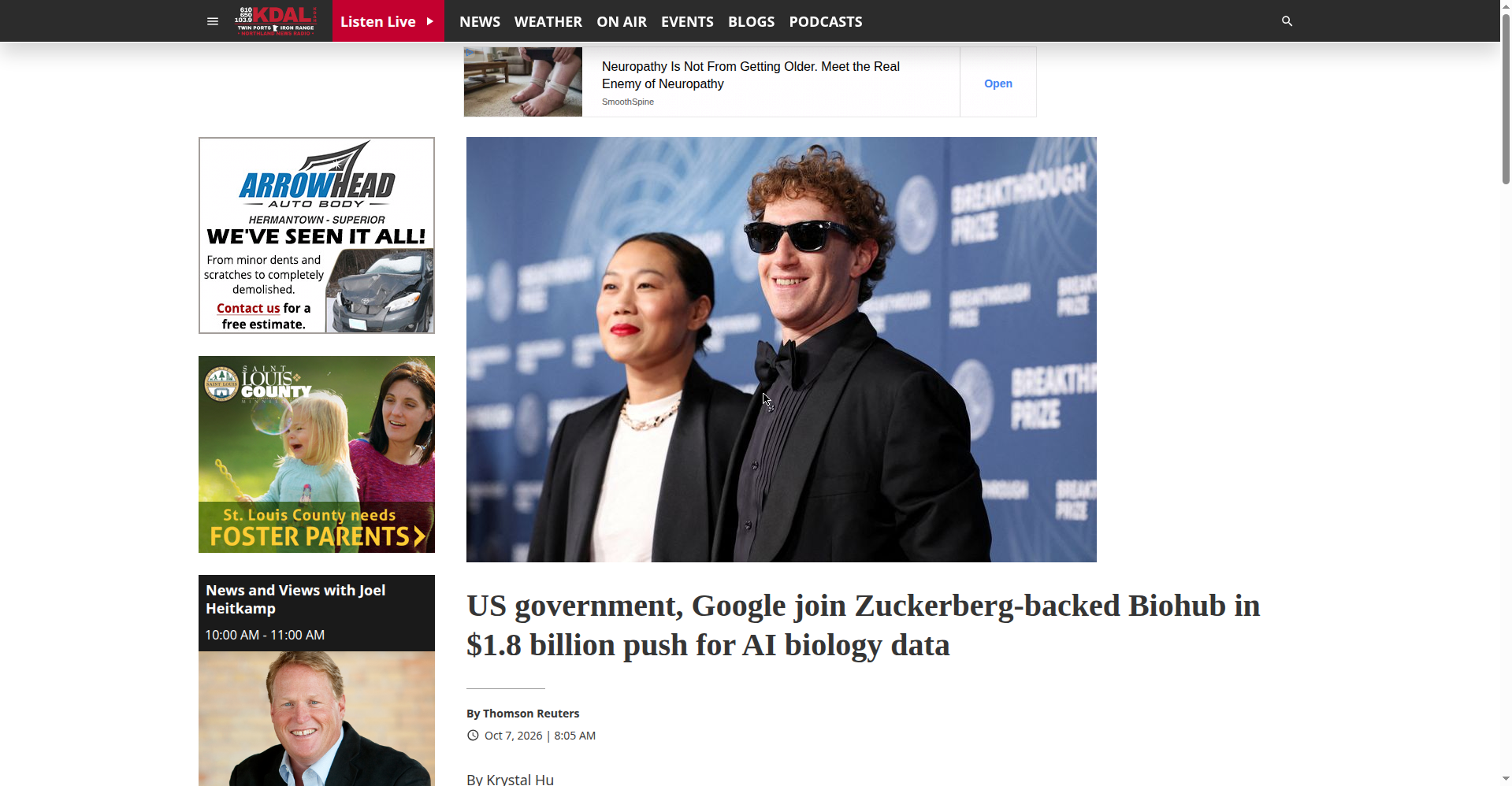
On October 7, the nonprofit research institute Biohub — funded by Mark Zuckerberg and Priscilla Chan — announced that its Virtual Biology Initiative has grown from a $500 million solo pledge in April into a $1.8 billion multi-party alliance. New members include Meta, Google DeepMind, Isomorphic Labs, plus the US Department of Energy and the NIH.
One goal: build the “virtual cell.” Feed a model a drug, a mutation, or a disease, and it predicts what the cell will do — no lab experiment required. Biohub reportedly calls it “the largest AI-ready biological data generation effort to date.”
How the $1.8B Adds Up
First, clarity: part of the $1.8B was pledged before:
- Biohub itself committed $500M in April.
- Meta, Google DeepMind, and Isomorphic Labs put in $300M combined.
- The US Department of Energy will invest over $500M over five years in experimental measurement, modeling, and compute, through the “Genesis Mission” AI science program.
- The NIH isn’t adding new money; it coordinates datasets and repositories built with over $500M in prior federal funding, which Biohub will curate into AI-trainable formats.
- NVIDIA provides compute infrastructure, software, and technical support.
Biohub’s science chief Alex Rives told Reuters they’ll next approach pharma companies and philanthropies — the alliance may keep growing.
The Problem: Not Enough Biological Data
AI training isn’t short on text — it’s short on high-quality structured biological data. Rives says today’s cell datasets cover hundreds of millions of cells; accurate predictive models need billions, eventually trillions. Biohub’s goal is to close that gap.
Where does the data come from? Two technical routes: spatial transcriptomics, mapping molecular activity in intact tissue; and screening experiments, recording how cells respond to environmental changes. Much of this data was never produced systematically before — that’s the initiative’s core work.
Timeline: Five Years
Rives says the work would normally take decades; the alliance plans to compress it to five years: first datasets in about a year, an accurate predictive model within five.
One Detail: Funders Get First Look
All data will eventually be public, but with an embargo: commercial funders get internal use for a period before it becomes an open scientific resource. Rives frames this as how “open science” attracts private money: the government-funded portion has no such restriction and goes public directly.
The Landscape: An AI-for-Science Arms Race
This isn’t isolated. Reuters noted Anthropic is doubling down on biology (it has built wet labs); the OpenAI Foundation launched a $125M+ grant program specifically for biology and medical datasets.
See what this round is really about: everyone can train model architectures — what’s missing is “AI-ready” data. Whoever holds structured, high-quality biological data has the edge on the AI-for-science track. Biohub just put Meta, Google, and the US government at the same table, raising the data-production ante to the $1.8B level.
Two things to watch: what the first datasets actually look like a year from now, and whether pharma and philanthropies follow with funding. The former decides the initiative’s technical substance; the latter decides whether it grows from a government-led project into sustainable industry investment.