资讯
Meta Ships Its First Frontier Model: Muse Wonder
Meta's Superintelligence Lab has released Muse Wonder and Muse Wonder Full, its first frontier-class models, priced at $4/$20 per million tokens. The stronger Wonder Full is locked to Muse Code subscribers, and independent benchmarks place the pair close to — but behind — Claude Opus 5.5.
Meta enters the frontier race
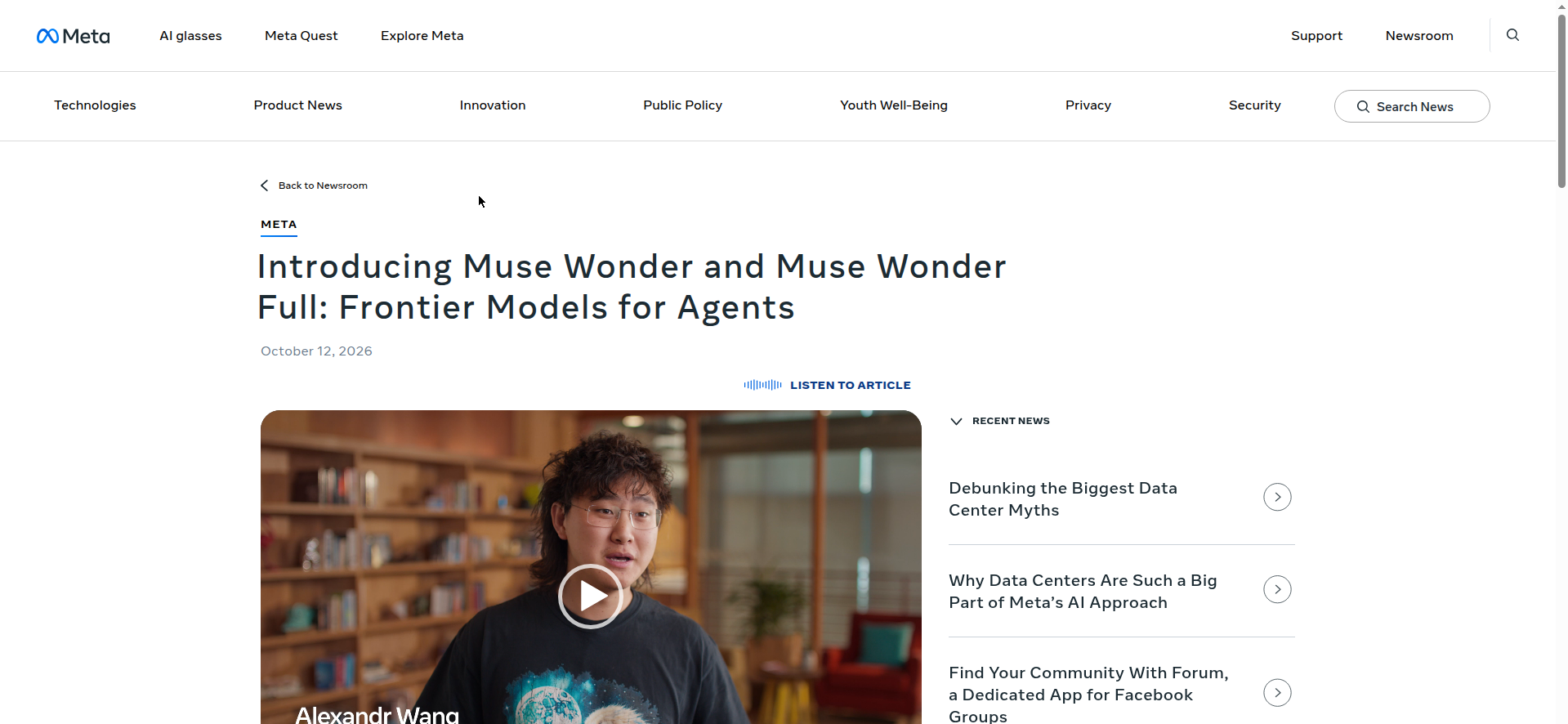
On Monday, October 12, Meta’s Superintelligence Lab released Muse Wonder and Muse Wonder Full, describing them as the company’s first frontier-class AI models. The pair sits above Muse Spark, the lightweight, low-latency model Meta launched earlier: Wonder is bigger, scores higher on benchmarks, and is aimed at harder work like complex coding tasks.
Meta’s own testing, laid out in the models’ model card, puts Wonder and Wonder Full in the same range as Claude Fable 5.1 and GPT-6 Astra. The launch post calls them “the next step on our scaling ladder and a major leap toward personal superintelligence.” Both models will also power Meta’s Muse personal agent going forward.
The lab behind them is the unit Meta assembled under former Scale AI chief Alexandr Wang, after a roughly 14-month build-out. Meta has framed the effort as a bet on frontier capability rather than on open weights — and the release confirms that framing.
What the independent numbers say
Independent testing tells a more tempered story than Meta’s own charts. On Artificial Analysis’s Intelligence Index, Muse Wonder scores 52 and Muse Wonder Full scores 56. For comparison, Claude Opus 5.5 scores 58, Claude Sonnet 5.5 scores 56, and GPT-6 Astra scores 53. Wonder Full sits level with Sonnet 5.5 and a point behind Opus 5.5 — a frontier model, close to the leaders, but not a clear winner.
Coding is where Meta pushes hardest. The company reports that Muse Wonder Full jumped from 33% to 57% on Terminal-Bench 4.0 and hit 68 on the Coding Agents Index, matching top models from Anthropic and others. On the other side of the ledger, factual knowledge remains a weak spot: 30 points on the AA-Omniscience test, lower than rivals. And one detailed teardown of Meta’s own model card noted that Wonder loses 9 of the 14 benchmarks Meta itself published — the strong results are real, but so is the cherry-picking.
The fair reading: Meta is now genuinely in the frontier conversation for agentic and coding work, with a model that trades blows with Sonnet 5.5 and Astra, while Opus 5.5 still leads overall.
The API catch: Wonder Full is subscription-only
Only one of the two models is available through the Meta Model API, where Muse Wonder lists as muse-wonder-1.0 at $4 per million input tokens and $20 per million output tokens. That matches Claude Opus 5.5’s list price exactly and sits close to GPT-6 Sol’s pricing.
Muse Wonder Full — the version Meta’s own testing shows as the strongest of the pair — is not served through the API at all. Access requires a Muse Code subscription: $50 per month for the Power plan or $200 per month for the Maximum tier. Meta has not published an API price for Wonder Full, and it is unclear when or whether that changes.
This is a notable commercial choice. Meta is keeping its best model inside its own developer product rather than selling it as raw API capacity, a bundling strategy the other frontier labs have not used for their flagships.
Active Memory and Active Focus
The two capabilities Meta is marketing hardest are “Active Memory” and “Active Focus.” Active Memory is about carrying context across sessions — remembering what matters to a user over days, weeks, and months. Active Focus is meant to keep multi-step agents from drifting as they navigate between apps and long task chains.
To back the memory claim, Meta highlighted MemoryBench, a benchmark that tests continual learning and memory construction. According to the company, Muse Wonder now scores higher on MemoryBench than Fable, Opus, or Astra — though the launch materials do not publish the raw per-benchmark numbers behind that claim.
“We put a tremendous amount of effort into making sure your model can remember what’s important to you over days, weeks, months, and beyond,” said research scientist Kavya Kopparapu in a video accompanying the launch.
The models take text, image, video, and audio as input, output text, and carry a context window of about 1 million tokens. Meta demonstrated them with four demo apps: a 3D kitchen game, a run planner, a custom gift planner, and a wedding seating chart — all tasks that reward the long-context, multi-step persistence Meta is pitching.
Closed, not open: the end of the Llama era
Unlike Meta’s earlier Llama releases, Muse Wonder is a closed model. It is available only through Meta’s API, Muse Code, and Meta’s own apps. Meta has not said whether it will ever release the weights.
That is a real turn. Meta spent years as the open-weights champion while Google and OpenAI charged for frontier access. With Wonder priced at frontier rates — $4 in, $20 out — and the best version kept behind a subscription, the open-weights era at Meta now looks like a phase, not a principle.
Whether Wonder earns that pricing depends on what developers find in practice. The independent benchmarks say it is a solid second-tier frontier model; Meta’s marketing says it is a step toward personal superintelligence. The gap between those two readings is where the next few months of real-world testing will matter.