资讯
Z.ai Debuts GLM-Legal, a Legal Agent Built on GLM-5.3-Flash
Z.ai has released GLM-Legal, a legal-domain agentic model built on its 320B-parameter GLM-5.3-Flash, scoring 19.2% all-pass on Harvey's LAB benchmark across 24 practice areas. Access is currently gated behind a design-partner application.
A legal specialist from the GLM family
On October 12, Z.ai unveiled GLM-Legal, a legal-domain agentic model built on its GLM-5.3-Flash base. The base is a 320-billion-parameter mixture-of-experts model with 18 billion parameters active per token and a 1-million-token context window — the same architecture that made GLM-5.3-Flash one of the most interesting open-weight releases of the summer, cheap to run and strong on coding and agent tasks.
GLM-Legal is the specialized version: the same efficient backbone, retrained and tuned for legal work. It is built for agentic use — multi-step tasks, tool use, long documents — rather than single-turn question answering.
19.2% on Harvey’s LAB benchmark
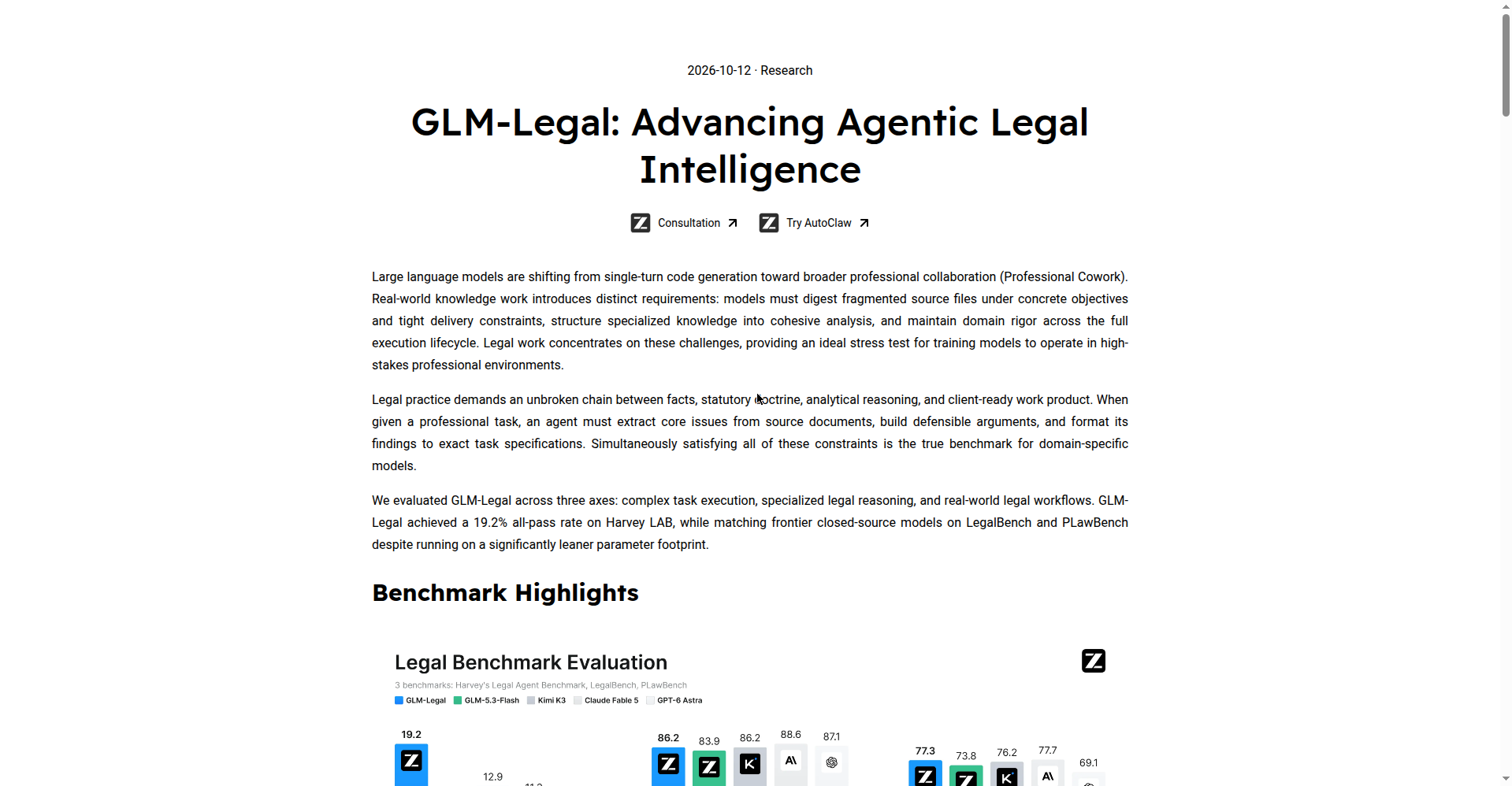
The headline number comes from Harvey’s LAB benchmark, a legal-industry test that spans 24 practice areas. GLM-Legal scores a 19.2% all-pass rate — meaning it completes the full task correctly, without errors, in just under one in five cases.
That sounds low until you know the test. All-pass rates on legal benchmarks are brutal because a single mis-cited clause or missed exception fails the whole task. The more telling number is the delta: 19.2% is a 12.5 percentage-point gain over the GLM-5.3-Flash base model, which puts the base at roughly 6.7%. Specialized training more than doubled the success rate on professional legal work.
Z.ai also cites matching frontier performance on LegalBench, the widely used academic legal benchmark. As always with vendor-reported numbers, independent evaluation will be the real test — but the direction is clear: domain tuning moves the needle far more than raw parameter count for this kind of work.
Gated access, for now
Unlike the MIT-licensed GLM-5.3-Flash base, whose weights anyone can download and self-host, GLM-Legal is launching with restricted access. Z.ai is gating it behind a design-partner application form, plus availability in the AutoClaw desktop app.
The gated rollout follows a familiar pattern for domain models: work closely with a small set of professional users first, harden the product against the failure modes that matter in that industry — in legal, a wrong answer is not just embarrassing, it is a liability — then widen access. For a model aimed at lawyers, the caution makes sense. The base model’s openness also means the community can build its own legal variants in the meantime, and probably will.
The reaction
The release hit Hacker News the same day, drawing 294 points and 163 comments — strong numbers for a domain-specific model, and a sign that developers see legal work as one of the next real markets for agents. The thread’s interest centered less on the benchmark number and more on the architecture story: a 320B model that only activates 18B per token is cheap to serve, and cheap serving is what makes always-on domain agents economically viable.
That economics argument is the real story behind GLM-Legal. Frontier general models can do legal work, but they are expensive to run at the volume a law firm’s document pipeline demands. A lean specialist that clears the bar on domain benchmarks at a fraction of the serving cost changes the math — the same logic that has driven the whole industry toward smaller, cheaper models this year.
The GLM-5.3 family it comes from
GLM-Legal sits on top of a busy two months for Z.ai. GLM-5.3-Flash landed on August 26 as a 320B-total, 18B-active mixture-of-experts model with a 1-million-token context, MIT-licensed open weights, and hosted pricing around $0.15 per million input tokens and $0.50 output — cheap enough to make high-volume agent workloads economical. Two days later came the GLM-5.3 flagship, roughly 744B total parameters with about 40B active, published on Hugging Face under a bespoke GLM-5.3 license that includes a security-review clause for model-as-a-service businesses above $10 billion in revenue. The flagship has since landed on AWS Bedrock for enterprise customers.
That two-tier setup explains GLM-Legal’s design. Z.ai picked the Flash tier — the lean, cheap, openly licensed one — as the backbone for a vertical agent, rather than the bigger flagship. For a domain product where the margins come from serving thousands of document-heavy workflows, the 18B-active footprint is the feature, not a compromise.
Why domain models keep coming
GLM-Legal is part of a broader wave. Labs are finding that the last mile of capability in professional domains — law, medicine, finance, engineering — comes from specialized training and agentic scaffolding, not from scaling the base model further. Harvey itself, whose LAB benchmark Z.ai is citing, builds legal AI on top of other labs’ models; now the base-model labs are moving into Harvey’s territory directly.
The competitive picture is getting crowded. Every major Chinese lab now has a domain-model strategy, and the US labs are doing the same through industry-tuned variants and partnerships. The differentiator is shifting from who has the biggest model to who has the best task-completion rate in a specific professional workflow — and, crucially, who can serve it cheaply enough that firms will actually deploy it.
For Z.ai, GLM-Legal is also a statement about the GLM-5 series as a platform: one efficient backbone, spun into vertical agents. If the design-partner phase produces the liability-grade reliability legal work demands, expect the same treatment for medicine, finance, and code review next.