News
PewDiePie Releases Local AI Model Ajax: OpenAI Banned His Account Twice Over "Distillation"
YouTuber PewDiePie released a homemade local AI model, Ajax (fine-tuned from Qwen3.5-9B), saying OpenAI banned his account twice during development — because he used OpenAI model outputs as training data for Ajax, i.e., distillation.
What Is Ajax
PewDiePie’s real name is Felix Kjellberg. On October 2, in a video titled “I seriously should NOT be dropping this,” he unveiled Ajax. Per Tom’s Hardware and others, Ajax is fine-tuned from Alibaba’s Qwen3.5-9B — 9B parameters, aimed at a local agent that runs on a home computer.
Ajax serves his self-built, self-hosted workspace Odysseus. It’s a persistent personal assistant: web search, browsing, email, calendar, and task management — all processed locally, nothing through the cloud. Odysseus launched this May as a free, open-source, self-hosted ChatGPT alternative, with session data stored on the user’s own hardware.
Ajax currently has no model card, no published benchmark scores, and unconfirmed weight licensing. At launch, the download link redirected to a training-data collection page. PewDiePie says early tests show Ajax completing tasks about nine times out of ten. Next up: reinforcement learning, a second round of “de-censoring,” quantization, then benchmark scores.
Banned Twice
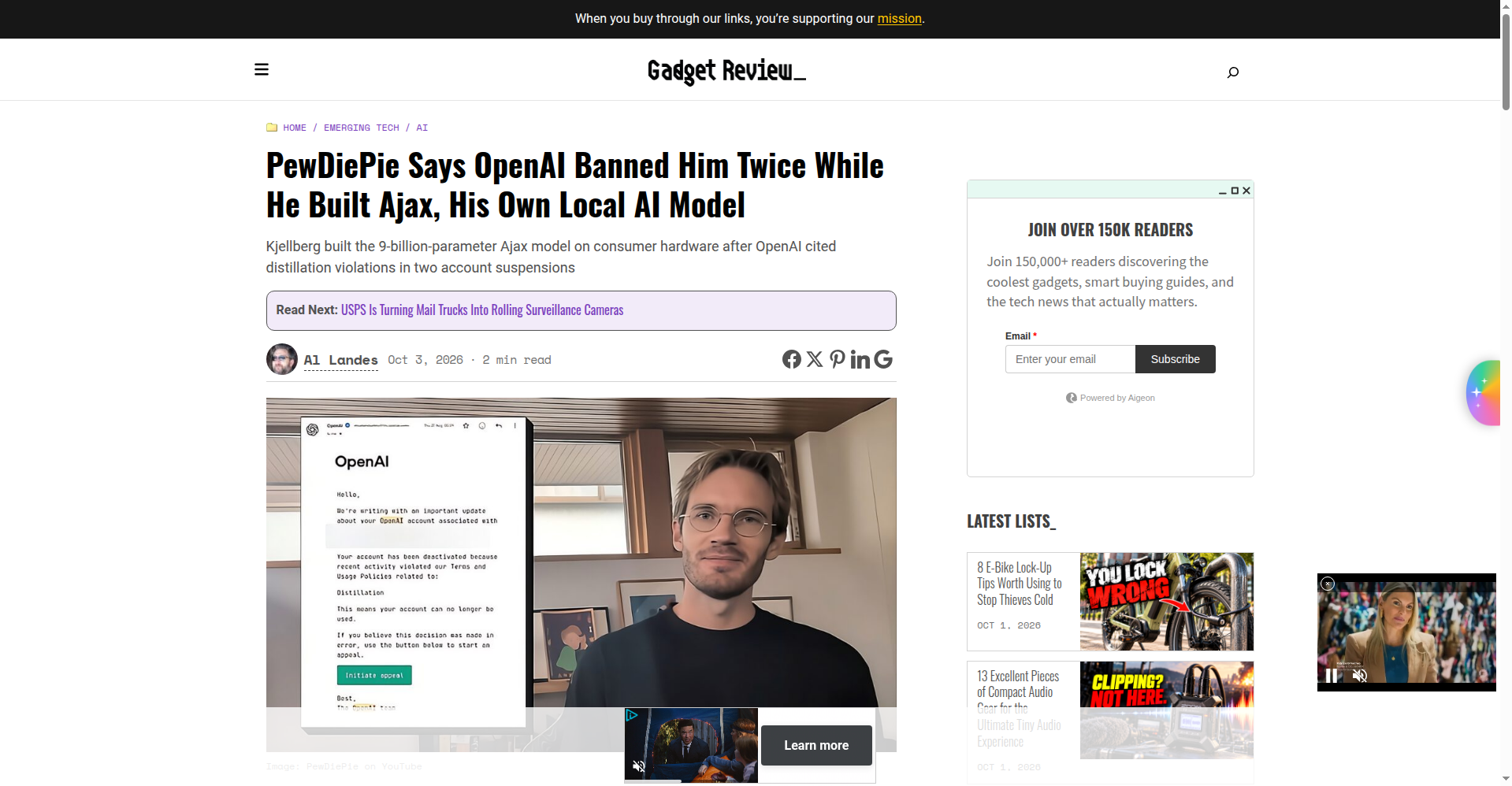
The ban story got the most discussion in the video. PewDiePie showed an email from OpenAI. The first ban cited “distillation” — using a large model’s outputs as training data for a smaller one. He appealed and the account was restored. Then he used OpenAI model outputs to generate Ajax’s seed training data, and the account was banned again.
OpenAI’s terms prohibit using its outputs to develop competing models, and bar automated, programmatic extraction of outputs. Technically, distillation is a common method — OpenAI itself acknowledges it’s a standard way to build training data for small models. The problem is the terms carve out that use.
To be clear, OpenAI hasn’t commented publicly on the PewDiePie case. All ban details come from his video and the email he showed.
“De-Censoring” and the Cost He Admits
Ajax’s other selling point is “no censorship.” PewDiePie ran the weights through the open-source tool Heretic for automatic abliteration, stripping refusal behavior on ordinary requests. He stresses Ajax keeps a floor: no actionable instructions for harming others or oneself. He’s also blunt about the cost: fewer guardrails, more room for abuse.
Bigger Than One YouTuber’s Story
In industry terms, this lands on two sensitive lines.
First, the boundary between “learning” and “stealing.” Days before Ajax went public, OpenAI disclosed a Moonshot-related reasoning-extraction incident. Distillation was the standard way for small models to catch up. Now that frontier labs encrypt or hide reasoning chains, distillation shifts from “learning” to “stealing” in the terms-of-service sense. PewDiePie asked in the video: how did they even detect it? That labs can detect large-scale distillation is itself news.
Second, open-weight accessibility. A 9B-parameter model runs on a decent consumer GPU or Mac. A decade ago, building a competent personal assistant took a team; now a content creator can fine-tune one in a living room. Ajax’s point isn’t that PewDiePie is special — it’s that the bar has dropped this low.
Next: whether Ajax publishes benchmark scores and weight licensing, and whether OpenAI responds at all.