News
OpenAI Drops 722 Math Papers at Once: Unreleased Model's Solutions, Open on GitHub
On October 6, OpenAI published 722 math manuscripts solved by an unreleased frontier model to GitHub, open-sourced under Apache-2.0, some proofs with Lean formal verification. Its third math release in nine weeks drew a split reaction: applause from some, demands for evidence from others.
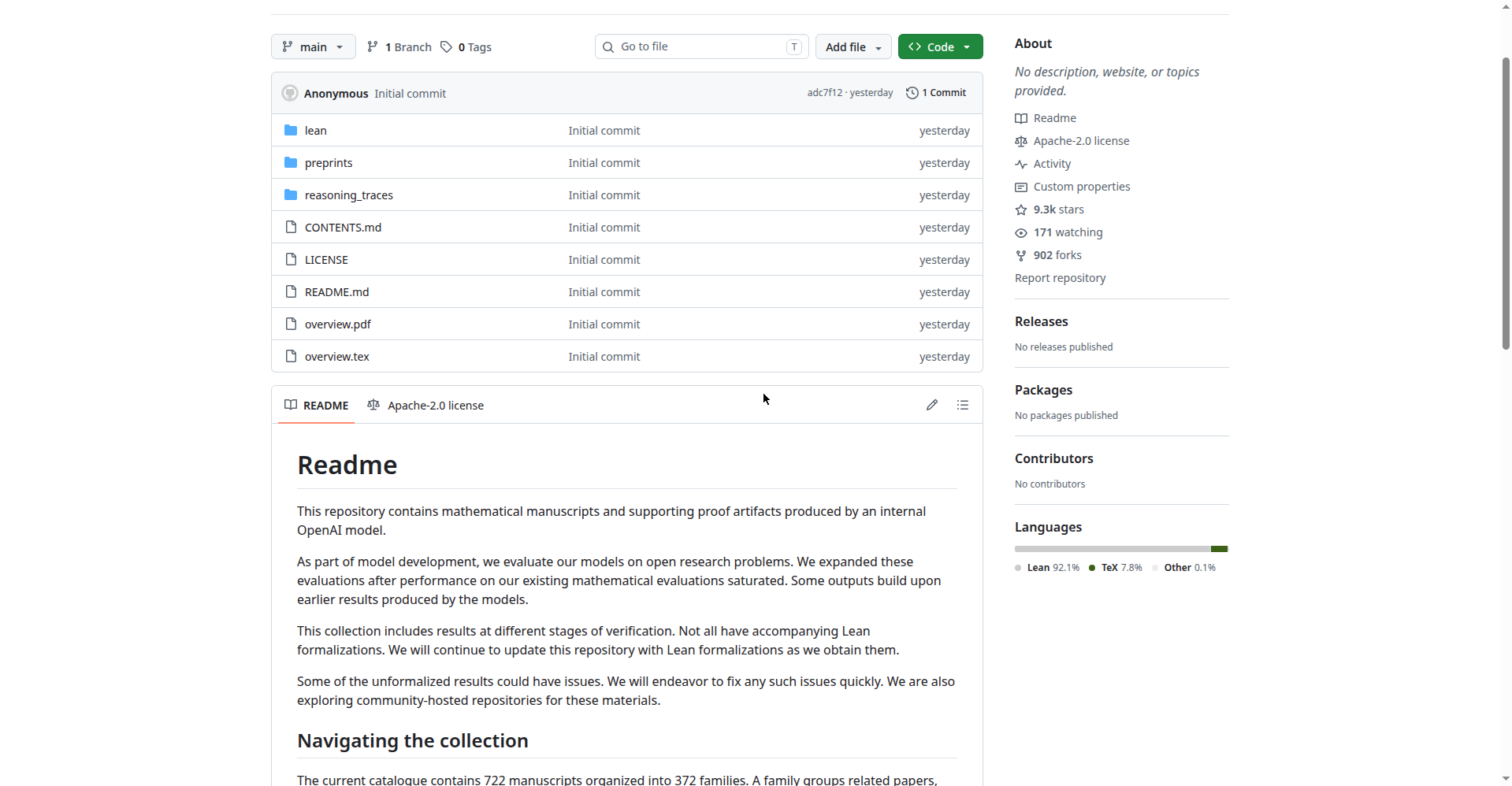
On October 6, OpenAI published a research article releasing 722 math manuscripts at once. The results come from an unreleased frontier model inside the company, all housed in the GitHub repo openai/math under Apache-2.0 — anyone can download and verify.
722 Papers, 372 Families
The 722 manuscripts are grouped by topic into 372 “families.” A family may hold a main result, supporting arguments, corollaries, or alternative proofs, each classified by math subfield.
Each manuscript gets its own directory: PDF, source, citation format, and build instructions. The repo also hosts a Lean formal-proof library listing which proofs passed machine verification. Every manuscript directory ships with a BibTeX entry for easy citing.
OpenAI says the model was given roughly 4,000 open problems; the less significant ones were filtered out, leaving these 722. Each result consumed, on average, about as much compute as three hours of ChatGPT Pro deep reasoning.
Not Every Paper Is Machine-Checkable
The repo’s README warns: not every manuscript has a Lean formal proof. Lean lets computers check proofs line by line — proofs with it are broadly trustworthy; without it, it’s still a PDF that needs human review. OpenAI says unformalized results may contain errors; fixes will be issued as new versions, with old versions retained.
Ten manuscripts include condensed summaries of the model’s reasoning, covering the Mahler conjecture, NP-hard problems, spin glasses, and the Vlasov-Maxwell system. Two special results took different paths: the zero distribution of the Riemann zeta function in the region Re(s) > 11/12, and a proof of the Hodge conjecture on CM abelian varieties. The zeta paper had human polishing for readability.
Mathematicians: Applause and Demands for Evidence
University of Toronto mathematician Daniel Litt calls it a good thing: now that answers exist, there’s no reason for a company to sit on them. MIT’s Andrew Sutherland wants evidence first.
Startup Fortune was blunter: many frontline mathematicians reacted with wariness, not applause. Dropping 722 papers at once overwhelms human peer review — which is exactly why OpenAI pushes Lean formalization: let machines absorb part of the review load.
There was one independent audit before. Someone on arXiv rechecked the 10 results OpenAI released August 1; spot-checked papers showed no substantive math errors, though review depth varied. Nobody has finished reviewing October’s batch.
Third Time in Nine Weeks
This release isn’t isolated. On August 1, OpenAI revealed an internal model called Astra with 10 results. Some problems hadn’t moved in a decade — including pushing the sphere-packing record forward, last advanced in 1978.
On September 8, OpenAI claimed its model found a finite-time blowup solution to the Navier-Stokes equations — one of the Clay Institute’s seven Millennium Problems — with a 166-page manuscript. Later OpenAI said it had also made substantial progress on the Hodge conjecture, though without proof details that time.
the-decoder noted a contrast: nearly every result in this 722-paper batch came from a single query to a single AI agent, while the Navier-Stokes effort used 10,000 agents and millions of dollars in compute. Getting results from one shot shows the model’s first-try capability in math is rising.
Mathematicians Were Consulted First
Before this release, OpenAI consulted an independent advisory group at Princeton’s Institute for Advanced Study: the “Mathematics and AI Advisory Group.” On September 29 it had just published responsible-release recommendations drawing on feedback from 600+ mathematicians.
The recommendations were specific: don’t test unreleased models on hard math problems; if the questioner doesn’t yet understand the result themselves, disclose the model name, prompts, reasoning summaries, and compute costs; don’t use math results as model marketing.
An OpenAI spokesperson said the company takes the guidelines seriously but isn’t bound by them. What was actually disclosed: average compute consumption, problem-attempt statistics, and 10 reasoning summaries. Prompts and the model name stayed private.
What It Means for You
For researchers, openai/math is a ready-made mine: 722 manuscripts with citation formats, some machine-verified, ready to review, use, and challenge.
For the AI industry, this release turns “can models do original math” from debate into auditable material. The evidence chain is public; so is the skepticism. What matters more than the release itself: how much real substance mathematicians can pull from these 722 papers in the coming months.