News
OpenAI Sets Codex a 28-Day Ultimatum: Ship One Improvement Daily or Full Reset
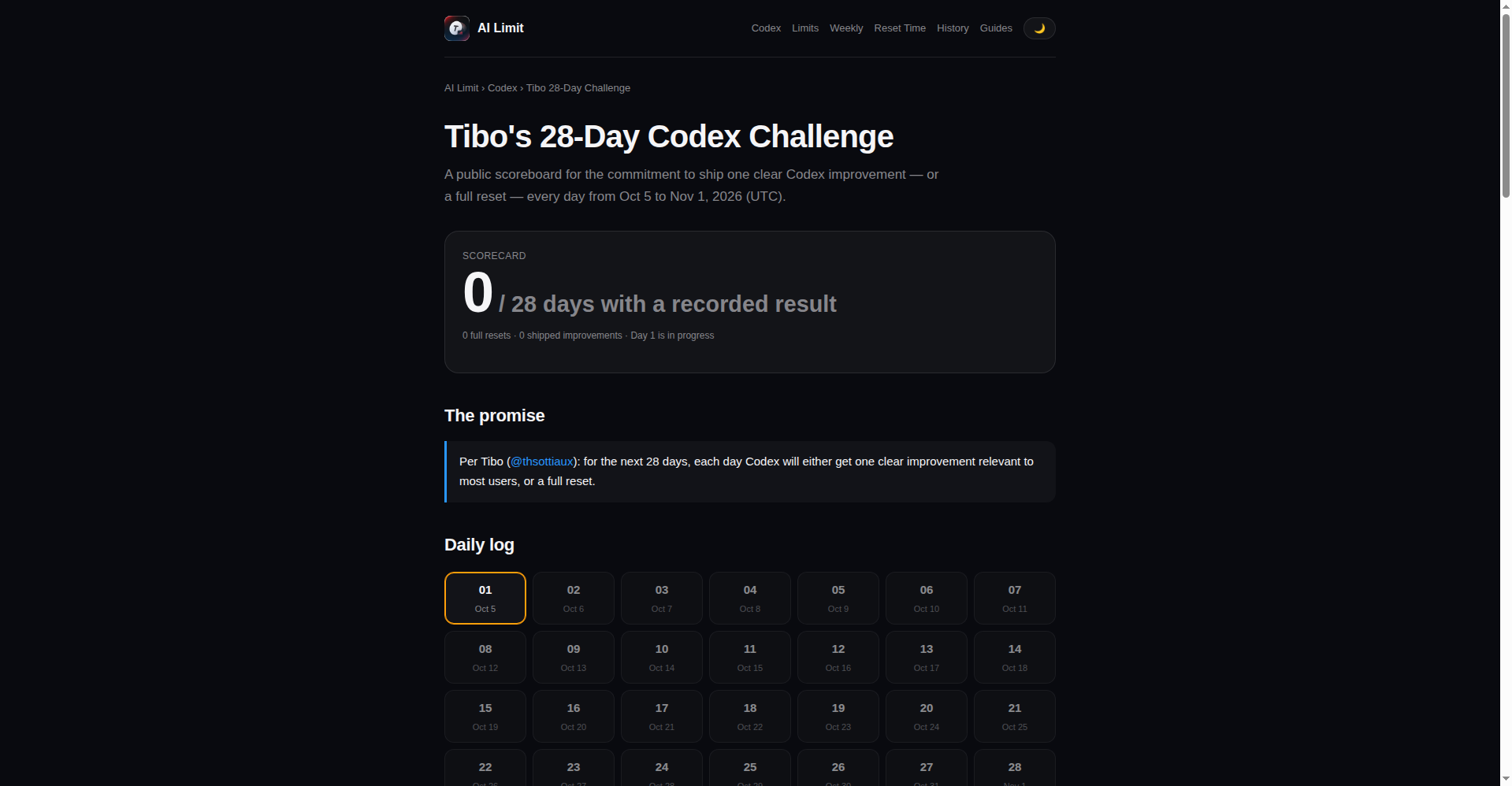
OpenAI Codex lead Tibo publicly committed: for the next 28 days, each day the team will either ship one clearly useful improvement for most Codex and Work users, or issue a full credit reset. The first time anyone turned "doing homework" into a public bet.
What Happened
On October 5, OpenAI’s head of product and platform Thibault Sottiaux — known as Tibo — posted on X. The original text:
“Over the next 28 days, each day we’ll either ship one thing that is a clear improvement and relevant for most codex/work users or ship a full reset.”
In plain terms: for the next 28 days, each day the team will either ship one improvement “clearly useful” to most Codex and Work users, or issue a full reset. Per the public scoreboard at ailimit.date/tibo-28, the challenge runs October 5 to November 1 (UTC), with day one already underway. Third-party sites have already turned the 28 days into a public scorecard, watching OpenAI do its homework.
Why Now
The day before the pledge, Tibo posted a scene-setter: refocusing on four things only — simplifying the product, more usage through efficiency, breakthrough features, and new models. He also admitted user feedback was unambiguous: people want simpler.
The bigger backdrop is credits. For weeks, Codex users’ top complaint has been quota: where the spend goes is unclear, and one runaway task can eat most of a week’s allowance. After DevDay’s GPT-6.1 Sol launch on September 29, server load spiked and speeds cratered; on October 2 Tibo apologized publicly and announced a global reset for all paid ChatGPT accounts the next day; on October 3 he was still chasing down Pro 500 users who missed the reset.
Credits have become OpenAI’s trust hole. This 28-day pledge fills it: ship improvements and users come back to try them; fail and hand out a free round of credits. Late delivery gets you a coupon — same logic.
The Competitive Undercurrent
There’s also pressure from next door. On September 22 Anthropic released Opus 5.5; about 90 minutes later OpenAI followed with GPT-6 Sol; a week later at DevDay, OpenAI pushed GPT-6.1 Sol at one-fifth of Astra’s price.
But user feedback has been awkward for OpenAI: GPT-6.1 Sol narrowed the gap, yet Opus 5.5 remains the ceiling at max reasoning effort — and plenty of Codex users feel Claude’s quota simply lasts longer.
The post drew some fire. Grok Bot’s Lauren Tan cracked a joke. Tibo shot back: “I challenge you to do the same.” Lauren replied only: “only you can win this battle.” Commenter Token Gremlin put it most bluntly: if none of the 28 improvements is a model that actually beats Opus 5.5, it won’t mean much to capability-focused users.
What to Watch Over the 28 Days
The rules leave wiggle room. What counts as “clearly helpful to most users” is undefined — does a bigger button count, does a usage-panel tweak count? The original post doesn’t say. But that’s what makes the bet interesting: the process is public, outsiders are watching, and failure means handing out free credits.
The worst case for users is a free credit reset every day; the best case is Codex genuinely getting a bit better daily. Credits can be given away repeatedly. The capability debt has to be repaid by models. After 28 days, checking the scoreboard against what OpenAI actually shipped will say more than any marketing.