News
Microsoft Unveils Maia 300, Its Third-Generation AI Chip
Microsoft on October 12 unveiled Azure Maia 300, its third-generation in-house AI accelerator. The inference-focused chip promises 40% more tokens per megawatt than leading GPU systems, with production deployments starting in 2027.
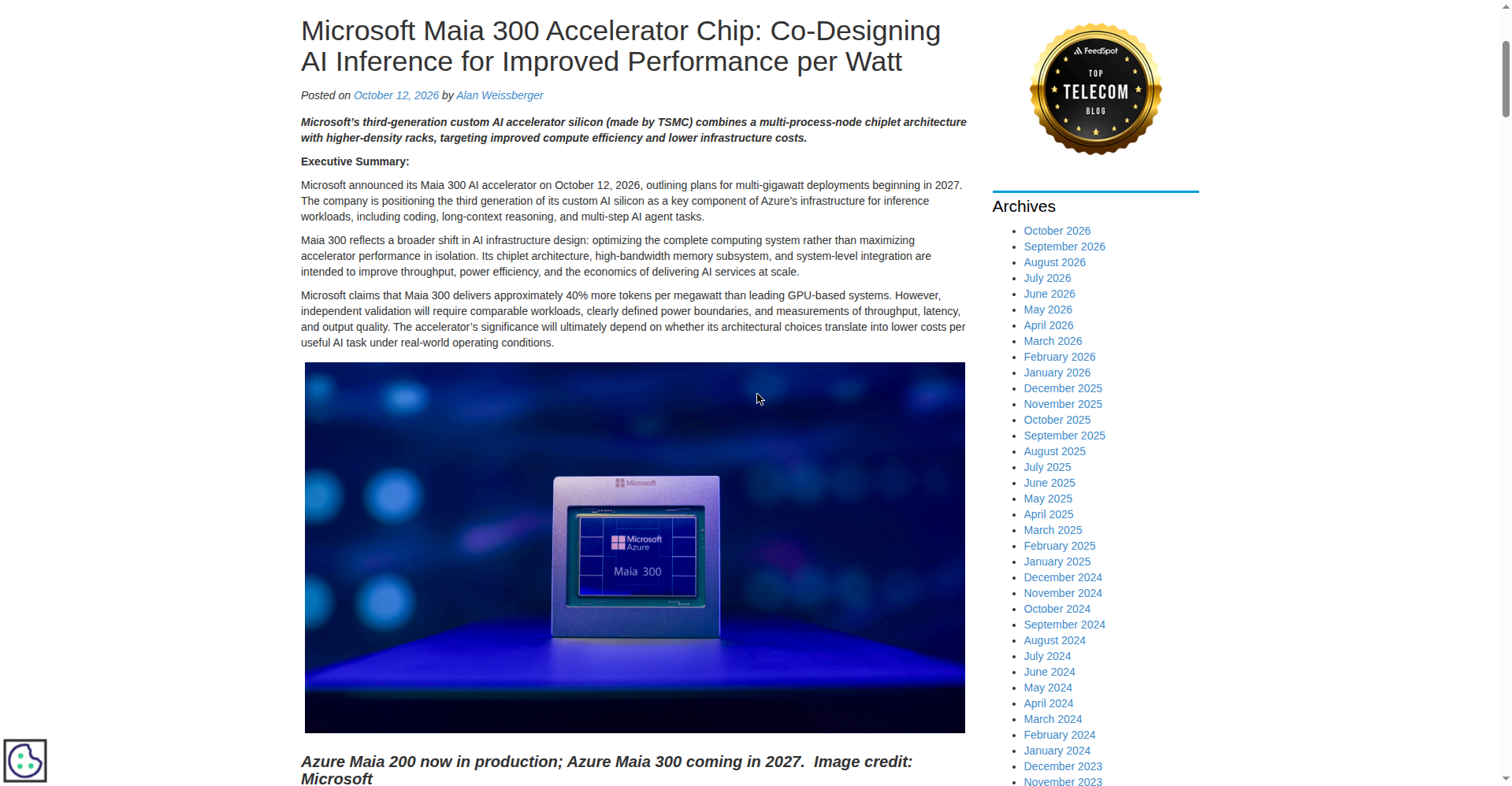
Microsoft is done renting most of its AI compute. On October 12, 2026, the company announced Azure Maia 300, the third generation of its in-house AI accelerator, and said it plans to make its own silicon the primary system running AI inference across its products.
Scott Guthrie, Microsoft’s executive vice president for Cloud and AI, made the announcement in an Official Microsoft Blog post, timing it with the OCP Global Summit in San Jose. The message was direct: starting in 2027, Microsoft will scale the Azure Maia family to multi-gigawatt deployments, and Maia chips will become the primary AI inference system for Microsoft’s products and services.
Built for inference, not training
Maia 300 is an inference chip. It is designed for the part of AI work where a trained model answers requests — chat responses, agent steps, code completions — rather than the part where the model is trained. Microsoft says the architecture is tuned for three workloads: long-context reasoning, latency-sensitive conversations, and sustained multi-step agentic tasks.
The chip uses a chiplet design built on TSMC’s N2P process, with compute, memory controllers, and I/O split across separate pieces of silicon. Microsoft says dedicating more die area to raw compute is what lets the chip deliver its headline efficiency claim: 40% more tokens per megawatt than what the company calls “leading GPU-based systems.”
Those figures are Microsoft’s own claims. No independent benchmarks have been published, and the company has not named the specific GPU systems it compared against. Treat the numbers as marketing-grade until third parties test them.
The rack is the product
Microsoft is pitching Maia 300 as a system, not a single chip. The design scales to racks of 96 accelerators, and at full rack scale Microsoft claims up to seven times the token throughput of its predecessor, Maia 200. That comparison is about the whole rack, not one chip versus another.
The memory story matters here. Each Maia 300 accelerator carries eight stacks of HBM4, up from six stacks of HBM3E in Maia 200, and 288 gigabytes of high-bandwidth memory per accelerator. Across a 96-accelerator rack, total HBM rises roughly 2.7 times compared with the previous generation. Microsoft describes the rack as operating within 167 kilowatts, and says the design cuts energy spent moving data between components.
For context, Maia 200 was announced in January and is already running production workloads. According to Microsoft, it currently powers Microsoft 365 Copilot, OpenAI models served on Azure, Microsoft’s own MAI models, and open-source models. Guthrie called Maia 200 “the best performing AI infrastructure in our fleet” based on real-world service metrics.
Why this matters now
Custom silicon is now a hyperscaler standard. Google is pushing to produce around 3 million TPUs this year and more than 5 million next year, and AWS has its own Trainium and Inferentia lines. Microsoft’s announcement puts it firmly in the same camp: building gigawatt-scale infrastructure around its own chips rather than buying GPUs from Nvidia and AMD.
The market noticed. Nvidia and AMD shares fell after the news, dropping by more than 1.5% and 3.2% respectively, according to Yahoo Finance reporting. The concern is structural: more than half of Nvidia’s quarterly revenue regularly comes from hyperscalers, and every inference workload Microsoft moves onto Maia is one that doesn’t run on Nvidia hardware.
That does not mean Nvidia is in trouble next quarter. Maia 300 production deployments start in 2027, and ramping multi-gigawatt datacenters takes years. But the direction is clear. Microsoft wants control of the full stack — from the model to the chip — and it is willing to spend billions to get it.
What to watch
Three things will determine whether Maia 300 is a real milestone or a press release:
- Independent performance data. Until a third party measures tokens per watt on comparable workloads, the 40% claim is unverified.
- Azure availability. Microsoft has not said when customers — as opposed to Microsoft’s own products — will be able to rent Maia 300 capacity, or at what price.
- Software maturity. Custom chips live or die on their software stack. Maia 200’s production record is encouraging, but a new chiplet architecture brings new drivers, new edge cases, and new tuning work.
If the efficiency claims hold up, the most direct consequence for developers is cheaper inference on Azure — and tighter integration between Microsoft’s models and the hardware they run on.
Sources: Official Microsoft Blog (via Scott Guthrie announcement post), Yahoo Finance, Seoul Economic Daily, IEEE ComSoc Technology Blog, Unite.AI, Oossa — reporting October 12–13, 2026.