News
Meta Open-Sources Muse Gadgets: Put the AI Agent on Your Own Soldered Circuit Board
On October 2, Meta open-sourced Muse Gadgets: ESP32 firmware and a Linux SDK under Apache 2.0, letting developers hook the Muse agent up to their own hardware. The companion reference device, Muse Home Link, got a 5,000-unit production run — free for US Muse subscribers.
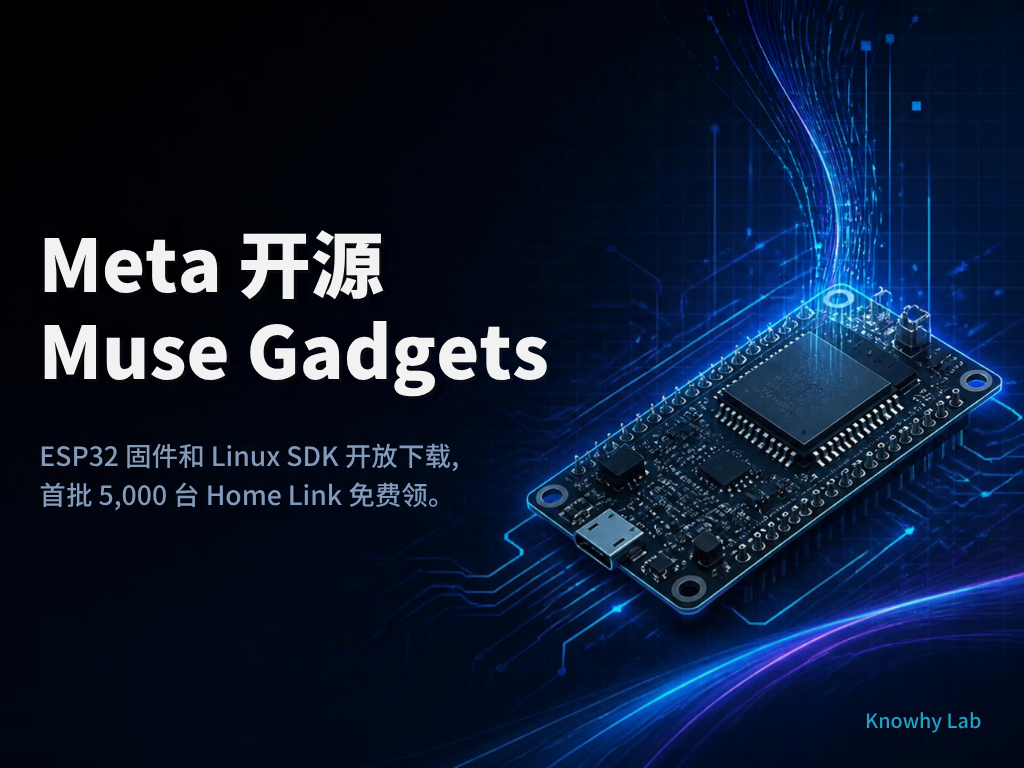
Meta handed its personal AI agent Muse over to the maker crowd. On October 2, Meta Superintelligence Labs product head Nat Friedman announced the open-sourcing of Muse Gadgets on X, with firmware and SDK all on GitHub under the Apache 2.0 license. Anyone can use an off-the-shelf ESP32 dev board or a Raspberry Pi to build hardware peripherals for Muse.
It’s a do-it-yourself project. Meta’s official description: “Muse gadgets are open source devices you build yourself” — flash an ESP32, or set up a Raspberry Pi 5, and with Meta’s SDK you can connect Muse to displays, buttons, sensors, and actuators, letting it operate physical devices on your workbench.
Friedman also suggested a new way to build: grab an API token at gadgets.muse.ai, point a coding agent like Claude Code or Cursor at the Muse Gadgets GitHub repo, and let AI generate the firmware code for you. Not hand-writing firmware yourself — that’s the most interesting step in the whole flow.
What You Can Build
Meta listed 7 example projects. Most use commercially available dev boards, which Meta does not endorse:
- Seeed reTerminal E1002: a color e-ink display for Muse’s “morning briefing.”
- M5Stack StickS3: pocket-sized, with a color screen and one button.
- AiPi Lite: a desktop trinket that talks.
- Raspberry Pi 5: hooked into Home Assistant, bringing Muse into whole-home smart setups.
- HDMI TV stick: the official page says “coming soon.”
Friedman also suggested directions: a color e-ink reminder board, an HDMI stick for the TV, a DIY touchscreen trinket like the Muse Charm (the Tamagotchi-style keychain device from Connect).
First Reference Device: Muse Home Link, Free
Meta built a reference device itself, the Muse Home Link. It’s a small USB-C-powered box that, once plugged in, lets Muse join the user’s home network and talk to every smart-home device exposing an HTTPS interface: TVs, speakers, lights, and other appliances.
Friedman said the first batch is 5,000 units. US Muse subscribers can claim one free, first come first served, with shipping expected in a few weeks. The Home Link reportedly uses an ESP32-C5 chip (per madrobot.blog; Meta has not confirmed this detail separately).
Meta Puts the Risks in Writing Too
Meta added an explicit warning to the docs: tinkering recklessly can brick the device or void the warranty (“Proceed at your own risk!”). A fair reminder: an AI agent that can operate your lights, TV, and printer — the more power it has, the costlier its mistakes.
One point worth noting is the permission structure. The code is open under Apache 2.0, but connecting hardware to Muse still requires an API token from Meta. The license gives you freedom, but Meta holds the switch.
Background: Muse Is Moving Faster and Faster
Muse launched on September 8, with the Connect conference making it the center of Meta’s consumer AI. Late-September moves included: a Mac version of Muse letting the agent operate desktop apps, and the Muse Charm keychain hardware reveal. On the business model, Zuckerberg said it plainly at Connect: Muse gives away generous free tokens and makes money on transaction cuts.
Gadgets extends that logic: not just building apps for phones and glasses, but letting the community put Muse into every corner that has a circuit board. Meta made 5,000 free units of hardware as starter fuel, then handed the baton to developers.