News
OpenAI Quietly Lists gpt-rosalind-discovery on Pricing Page — Drug Discovery Model Surfaces Before Any Announcement
An never-announced model name appeared on OpenAI's API pricing page: gpt-rosalind-discovery. It sits next to gpt-rosalind-research under "life sciences models" at identical pricing. Nothing but a name and a price — no blog post, no docs, no system card. The use case can only be guessed from the name: most likely a new Rosalind-family member focused on drug discovery.
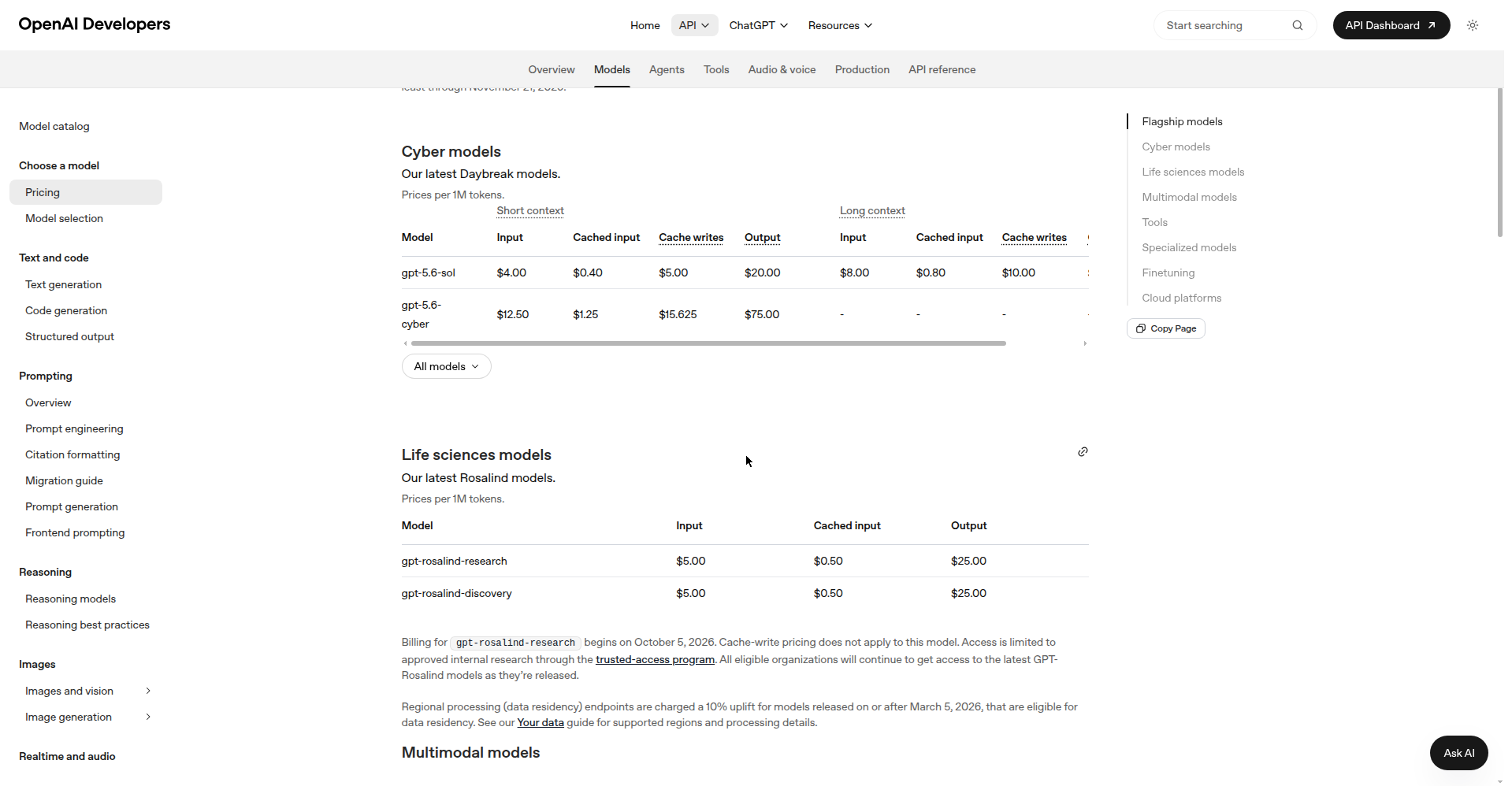
On October 10, the AI Tracker Bot on X spotted something new on OpenAI’s official API pricing page: a never-before-seen model called gpt-rosalind-discovery, sitting next to gpt-rosalind-research under “life sciences models.”
The pricing column is explicit: $5 per million input tokens, $0.50 for cached input, $25 per million output tokens — identical to gpt-rosalind-research. Access works the same way too: approved internal research only, through OpenAI’s trusted-access program. The page also notes that gpt-rosalind-research started metered billing on October 5, with no separate charge for cache writes.
Beyond the name and the price, OpenAI has said nothing. No blog post, no help docs, no system card. TestingCatalog confirmed: no trace of it in any official channel.
This isn’t OpenAI’s first “list first, announce later.” Its models routinely show up on the pricing page days before the announcement. So gpt-rosalind-discovery is probably not far from its formal debut.
The name is the only clue so far. Rosalind is OpenAI’s biology reasoning model, released in April and positioned for biology, drug discovery, and translational medicine. At launch, OpenAI named early partners including Amgen, Moderna, the Allen Institute, and Thermo Fisher Scientific. The Rosalind family timeline: graduated from research preview on September 11, available worldwide to qualifying organizations via trusted-access; metered billing began October 5; the latest version, GPT-Rosalind-5.5, is trained on GPT-5.5. OpenAI has also said qualifying organizations will keep getting the newest GPT-Rosalind models — a sentence that itself implies Rosalind is a family, not a single model.
“Discovery” maps to the upstream end of drug R&D: finding targets, designing molecules. OpenAI’s help center describes the existing model as best at “early discovery and hypothesis generation” — target biology, literature synthesis, omics data interpretation. A version dedicated to the discovery stage fits that logic. But to be clear: that’s inference from the name alone. Nothing confirmed.
On safety, OpenAI runs a “gated” playbook for these models: the model itself is trained not to refuse complex biology questions, with safety handled mainly through access approval. Same approach as when GPT-5.4-Cyber expanded trusted access. For life-sciences models, that’s now OpenAI’s fixed formula.
Rivals aren’t idle either. Anthropic built a biology mode, Claude Operon, into the Claude desktop app, and Claude Science is in closed beta. OpenAI itself has an “Academic Researcher” ChatGPT project. With Rosalind, OpenAI’s lab-facing puzzle is nearly complete.
Three things to watch: when the official introduction drops; whether it’s a newly trained model for discovery tasks or a fine-tuned variant of the research model; and whether access stays gated behind trusted-access like the research version. I’ll follow up once there are answers.