News
Zhipu's GLM-5.3 Lands on AWS Bedrock with Usage-Based Revenue Sharing
AWS announced Zhipu's flagship open-weight model GLM-5.3 is fully available on Amazon Bedrock, with AWS reportedly sharing revenue with Zhipu based on usage. 753B-parameter MoE, 1M-token context, aimed at agentic coding and cybersecurity.
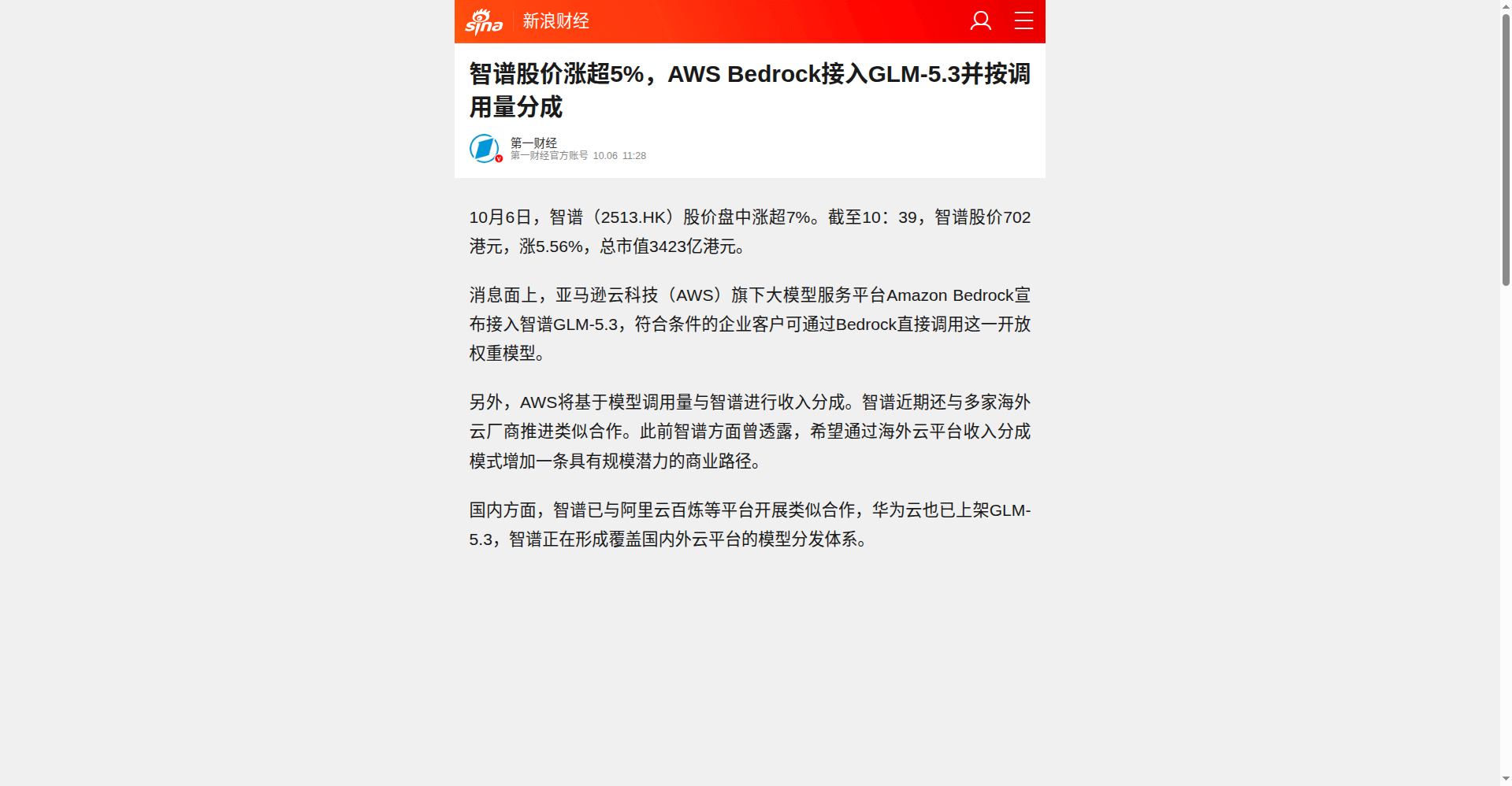
On October 5, AWS announced that Zhipu’s flagship open-weight model GLM-5.3 is fully available on Amazon Bedrock. Eligible enterprise customers can call the model directly on Bedrock.
According to the Science and Technology Innovation Board Daily, AWS will share revenue with Zhipu based on model usage. Zhipu has recently signed similar deals with several overseas cloud providers. Domestically, Zhipu has a revenue-sharing agreement with Alibaba Cloud’s Bailian platform, and Huawei Cloud already lists GLM-5.3. Both distribution lines — domestic and overseas — are running in parallel.
753B Parameters, 1M-Token Context
GLM-5.3 is a mixture-of-experts (MoE) architecture: 753B total parameters, about 40B activated per inference. Context length is 1M tokens, with up to 128K tokens of output per call. Reasoning is always on, and users can pick their own reasoning intensity, trading off latency, token spend, and task performance.
AWS positions it as an open model for agentic coding and cybersecurity. Z.ai claims GLM-5.3 is competitive on coding benchmarks like DeepSWE, Terminal Bench 3.0, and FrontierSWE, with a 50% improvement over GLM-5.2 on internal coding benchmarks and 84.5 on the CyberGym cybersecurity benchmark. These are Z.ai’s own numbers — AWS hasn’t independently verified them.
On the API side, two flavors are supported: OpenAI-compatible Responses and Chat Completions APIs, plus Bedrock-native Invoke and Converse APIs. Prompt caching is on by default.
Cloud Distribution: A First Revenue-Sharing Deal for a Chinese Model
Cloud distribution of models is a proven playbook overseas. Anthropic’s Claude has long reached enterprise customers through AWS Bedrock and Google Cloud. Per market reports, of Anthropic’s roughly $4.6B in 2025 revenue, about $2.16B (47%) came through the two clouds’ marketplace channels, with the two clouds collecting about $351M in distribution fees. In April, Anthropic said over 100,000 customers were running Claude on Bedrock.
For model companies, cloud platforms sell more than compute — global enterprise customers, account systems, payments, and compliance infrastructure. Model companies don’t have to build overseas sales networks themselves.
What’s different about GLM-5.3: it’s the first time AWS has done a revenue-sharing deal with a Chinese open-weight model. The tricky part with open-weight models is that enterprises can take the weights and self-deploy instead of calling the cloud API. The more open the weights, the faster the ecosystem grows — but self-deployment can also siphon revenue from cloud API calls. Whether revenue sharing works at scale depends on overseas enterprises actually using it consistently.
Six Chinese Models Entered Bedrock Together
Six Chinese open-weight models entered Bedrock in the same batch: DeepSeek V3.2, MiniMax M2.1, Alibaba’s Qwen3 Coder Next, and others. In September, Moonshot’s Kimi K3 got there first.
OpenRouter data shows Chinese models processed about 57.46 trillion tokens in the past week, versus about 16.2 trillion for US models. Chinese models going global has shifted from “getting overseas developers to use them” to “selling them on overseas cloud platforms.”
One Detail: US and Global Cross-Region Inference Only
Enterprises should note the data residency issue. GLM-5.3 is currently offered only through US and global cross-region inference profiles (profile IDs us.zai.glm-5.3 and global.zai.glm-5.3), with no in-region inference option. For institutions bound by data residency rules, where requests get processed is something to nail down before adopting.
Market Reaction: Zhipu Shares Jump Over 8% Intraday
After the news, Zhipu (2513.HK) jumped over 8% intraday on October 6. Financials show Zhipu’s H1 2026 revenue at 954 million yuan, up 399.7% year over year, with a net loss attributable to parent of 2.071 billion yuan. In September, Zhipu closed about $5B in funding, mainly for next-generation GLM foundation models and a fully self-trained stack.
Two things to watch next: how much real money the revenue-sharing terms actually bring Zhipu, and whether other cloud providers follow. DeepSeek, MiniMax, and Moonshot are walking the same path — whoever builds enterprise call volume first gets another stable revenue line.
Sources: AWS official announcement; Science and Technology Innovation Board Daily, IT Home, Sina Finance (Cailian Press), MoneyDJ; AWS Machine Learning Blog.