News
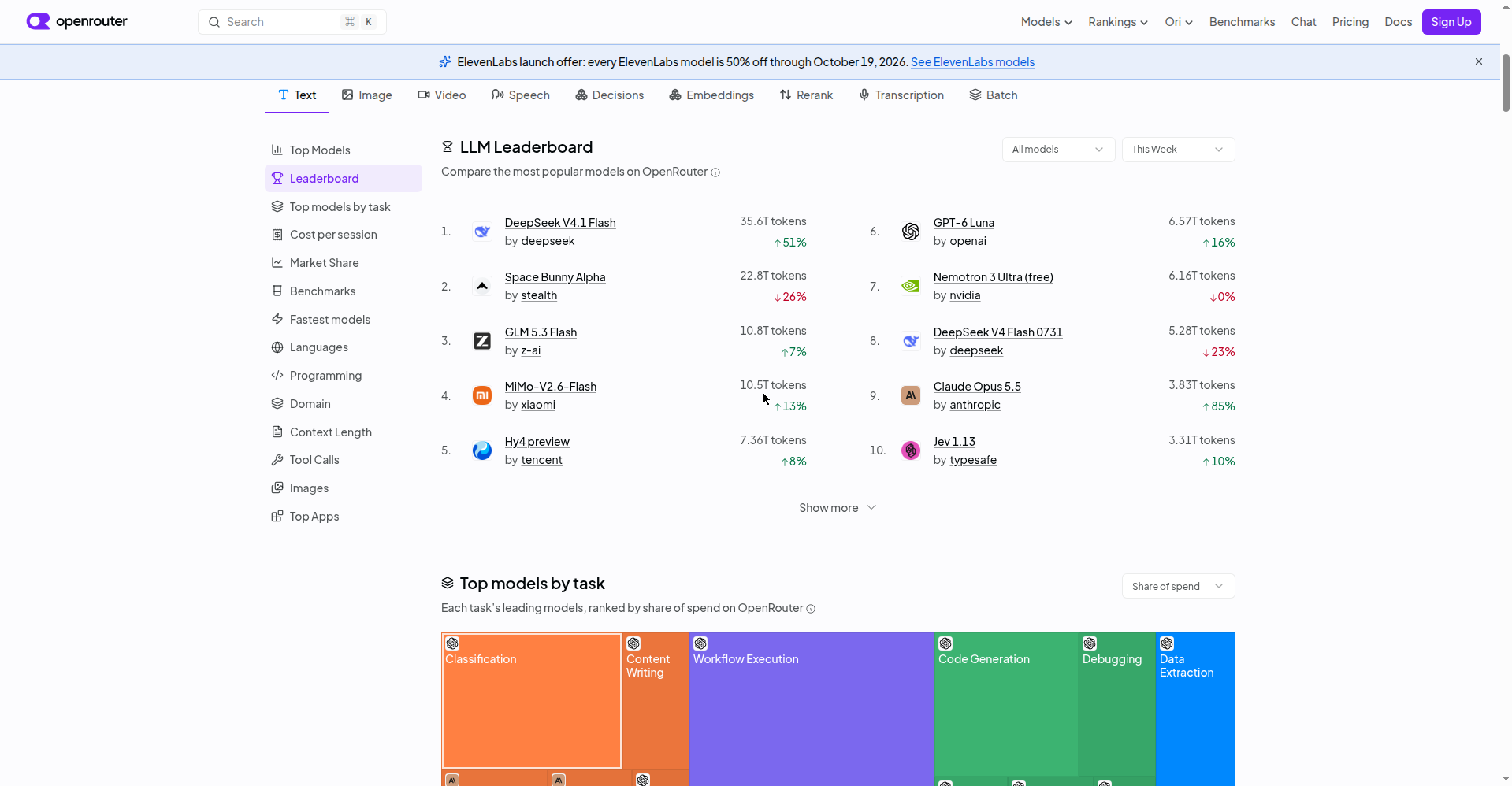
DeepSeek Processed 36.8 Trillion Tokens in a Week — More Than America's Big Four Combined
Per reports, VC firm Social Capital's analysis of OpenRouter data shows that in the last week of September, DeepSeek's models processed 36.8 trillion tokens on OpenRouter — more than OpenAI, Google, Anthropic, and xAI combined at 33.0 trillion.
The Numbers Themselves
In the last week of September, DeepSeek’s models processed 36.8 trillion tokens on the OpenRouter platform. The same week, OpenAI, Google, Anthropic, and xAI combined for 33.0 trillion.
Breaking it down: OpenAI 19.5 trillion, Google 6.8 trillion, Anthropic 6.1 trillion, xAI 0.6 trillion. DeepSeek alone beat the four of them combined.
The figures come from a statistical analysis by VC firm Social Capital based on OpenRouter data, first reported by media outlet MetaEra and relayed by KuCoin in an October 8 flash update. OpenRouter itself has never published these numbers — treat them with appropriate caution.
The Leaderboard Backs the Trend
On OpenRouter’s public leaderboard, DeepSeek V4.1 Flash ranked first over the past week, up 48%, with V4 Pro sixth. DeepSeek’s top three models processed nearly 6 trillion tokens in the week. By contrast, OpenAI’s GPT-5.5 fell to 15th, at about 470 billion tokens for the week.
This isn’t the first time. Data from Shanghai Metals Market (SMM) shows that in the week of September 14–20, weekly API call volume for Chinese AI models exceeded U.S. models for the 21st consecutive week. DeepSeek V4.1 Flash topped the chart then with 15.8 trillion tokens, up 219% week over week.
How to Read These Numbers
First, the caveats. OpenRouter is a model aggregation platform where developers call 400+ models through a single interface. Its public rankings are widely used to track model adoption, but they don’t represent all global token traffic.
VentureBeat cited a conservative estimate: OpenRouter traffic accounts for roughly 3% of global token flows. Direct API calls to vendors’ official APIs — enterprise customers of Anthropic and OpenAI, for example — are outside this frame.
But the frame still matters. Per the same reporting, OpenRouter handles 15% to 40% of OpenAI’s and Google’s token volumes, and the share keeps growing. What it reflects is developers’ real choices: whichever is cheaper and easier to plug in gets their vote.
It Comes Down to Price
The answer is blunt: price. DeepSeek V4.1 Flash costs $0.15 per million input tokens in the off-peak window and $0.30 at peak — among the cheapest in its class. Low price buys volume: V4.1 Flash once saw OpenRouter weekly usage surge 172%.
Which also explains why OpenAI and Anthropic have been cutting prices lately. OpenAI plans to cut GPT-6.1 Sol pricing by 50% for large customers; Anthropic says Opus 5.5 is 40% cheaper than Opus 5. The price war has moved from the margins into the flagship tier.
A price war only works if low prices buy real demand. DeepSeek’s numbers say the exchange is real.
Three Takeaways for Developers
First: open and open-weight models are being adopted by developers faster than closed giants — at least in the OpenRouter frame.
Second: price is becoming a more important competitive dimension than leaderboard rankings. The flagship price cuts from OpenAI and Anthropic were forced by it.
Third: don’t read just one leaderboard. OpenRouter’s data skews toward price-sensitive developers; enterprise usage looks different. For technical selection, use OpenRouter rankings as a trend reference, and your own tests plus official price sheets as the decision basis.
(Figures in this article come from Social Capital’s analysis of OpenRouter data via media reports; treat quoted numbers and conclusions as per the originals.)