News
Claude Goes Beyond Chat: Anthropic Launches Motion Animations and Dashboards
Anthropic launched two beta features on October 8: Dashboards plugs data sources into Claude to generate live-updating dashboards from a sentence; Motion turns text and charts into editable animated explainers. Docs, Slides, and Design also graduated from beta, free tiers included.
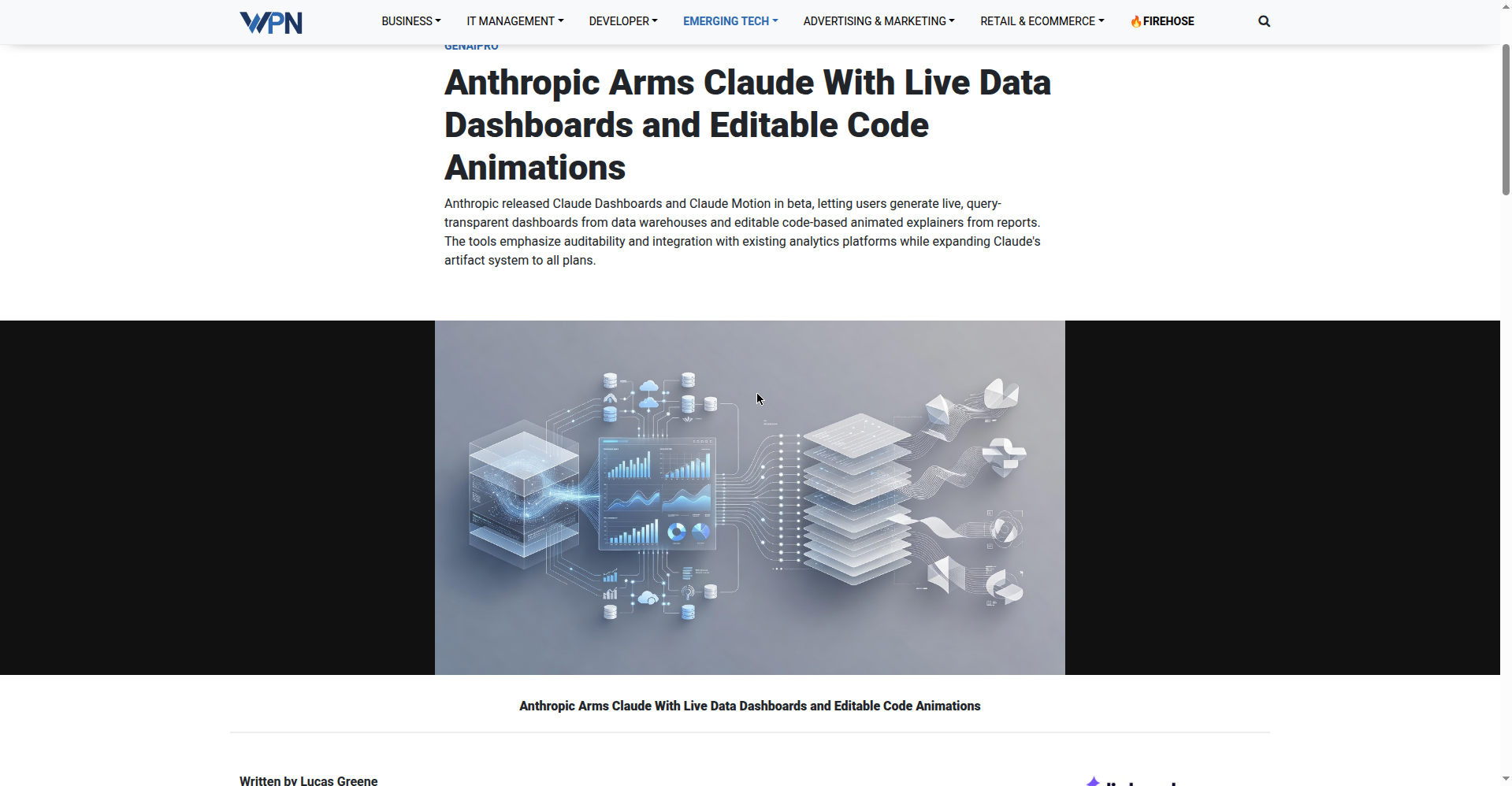
On October 8, Anthropic gave Claude two beta features: Claude Dashboards and Claude Motion. One handles “looking at numbers,” the other “making animations.”
Dashboards: Live Data Dashboards From a Sentence
Dashboards work simply. Connect your company’s data sources, ask in natural language, and Claude writes the queries, picks the charts, and assembles a live-updating dashboard. Data changes, dashboard follows.
Supported sources include Amazon Redshift, Google BigQuery, ClickHouse, Databricks, Snowflake, and Salesforce. Anthropic says Looker, monday.com, and Tableau support are on the way.
Two design details stand out. First, every number on a dashboard expands to show the query behind it — fully transparent logic. Second, each chart shows its last refresh time. At least you won’t present three-day-old data in a meeting as fresh insight.
Finished dashboards can be sent to Amplitude, Grafana, Hex, or Sigma for deeper digging. Anthropic’s positioning is modest: Dashboards are for “getting a number fast” — explicitly not a replacement for production BI platforms.
Motion: Turning Reports Into Editable Animated Explainers
Motion turns reports, charts, or product docs into short animated explainer videos. Launch it by typing /motion in the input box or picking Motion from the output options. Two ways to edit: change the code directly in the editor, or say in chat “change the Q3 number to 18%.” Export as MP4, or take it into Adobe, Descript, Runway, or Luma AI for further work.
Motion has one key difference: it doesn’t use video generation models. Claude writes the animation frame by frame in code — text, charts, shapes, and images moving per the script. So it can’t hallucinate AI-invented footage or generate fake people. Anthropic’s examples: a quarterly report becomes a 30-second all-hands explainer, new-customer onboarding guides, dynamic price comparisons.
There are costs. Motion counts against your Claude usage quota — longer animations burn more. Anthropic hasn’t published duration, resolution, or framerate caps. Access has gates too: Dashboards is for paid plans, Motion is Team and Enterprise only, and org admins must enable both manually.
Also Released: Docs, Slides, Design Go GA
The same announcement had good news: Claude’s Docs, Slides, and Design graduated from beta — all plans, including free accounts. Anthropic says users have generated over 45 million documents, decks, and designs with these tools.
The Direction Worth Noting
The direction is clear: Claude is morphing from “clever conversationalist” into “tool that makes things.” Motion’s approach is especially worth studying — instead of chasing photorealistic video, it turns animation into inspectable, editable code. Anyone who makes content knows the most expensive part of short video is never generation — it’s the seventh round of revision notes. Changing one line of code beats regenerating everything.
Whether to use it comes down to two things. First, price: Anthropic gave no separate pricing; access is tied to plans. Second, limits: hard specs like duration and resolution weren’t published for the beta — try it yourself before it goes GA.
Sources: Anthropic’s official announcement; coverage from WebProNews, The Decoder, testingcatalog, and aidailypost. Cover: WebProNews coverage screenshot.